
A Reality Check on Customer Experience in Utilities
Let’s start with an uncomfortable truth. Utilities have consistently ranked near the bottom of customer satisfaction studies.
According to J.D. Power’s Utility Digital Experience Satisfaction study, the utility digital experience is 616 compared to an average satisfaction score of 734 across industries.
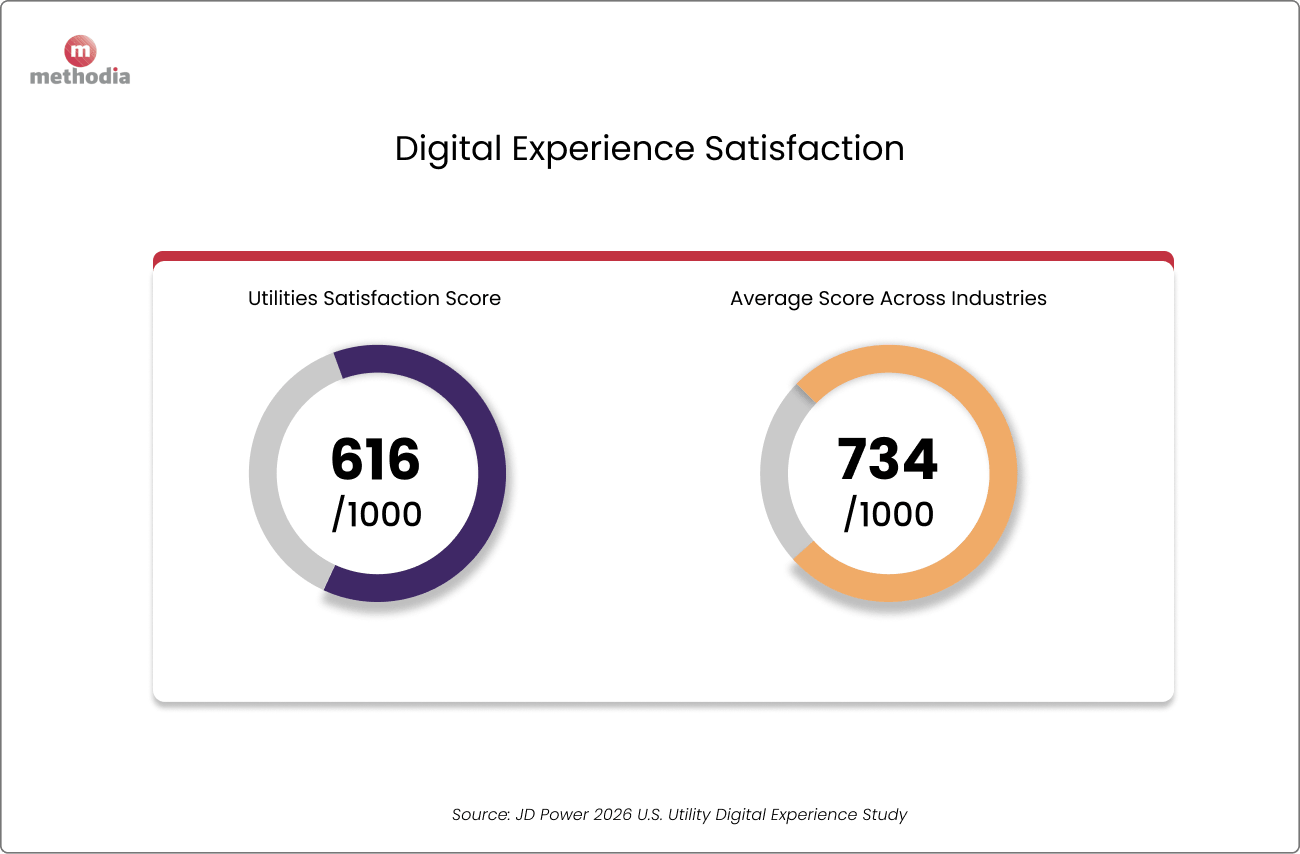
Utilities fall behind industries such as advised wealth management, banking, property and casualty insurance industry, etc.
The standard explanation is that utilities are compared unfairly because they are measured against the seamless experiences of Amazon or Netflix, sectors with very different economics and regulatory constraints. There is something about that argument. But it is also, to some extent, a way of avoiding a harder question:
If utilities have been aware of the gap for years and have invested to close it, why hasn’t it closed?
The answer is not that utilities lack will. It is the dominant approach of improving what customers see without fixing what drives it. In other words, it looks like they treat a structural problem as a surface one.
What CX in Utilities Actually Means
Customer experience in utilities is often discussed as if it were synonymous with customer service – the quality of interactions when something goes wrong.
In utilities, that’s only part of the story.
The real experience spans the entire customer lifecycle: onboarding, billing, meter readings, payment management, and eventual switching or moving.
Behind every one of these touchpoints sits a combination of systems:
- 3. Meter Data Management (MDM)
- 4. Market operations workflows
When those systems are fragmented or unreliable, the experience breaks regardless of how polished the interface looks.
This is a crucial distinction. A utility can invest heavily in a mobile app and still deliver a poor experience, because the app is only as good as the data and processes feeding it. Billing errors, inconsistent consumption data, and failed move-in processes are not UX problems. They are operational ones.
Why Customer Experience in Utilities Still Breaks Down
To understand why CX improvement in utilities stalls, it helps to be specific about the forces working against it rather than relying on the familiar “legacy systems” excuses as an all-purpose explanation.
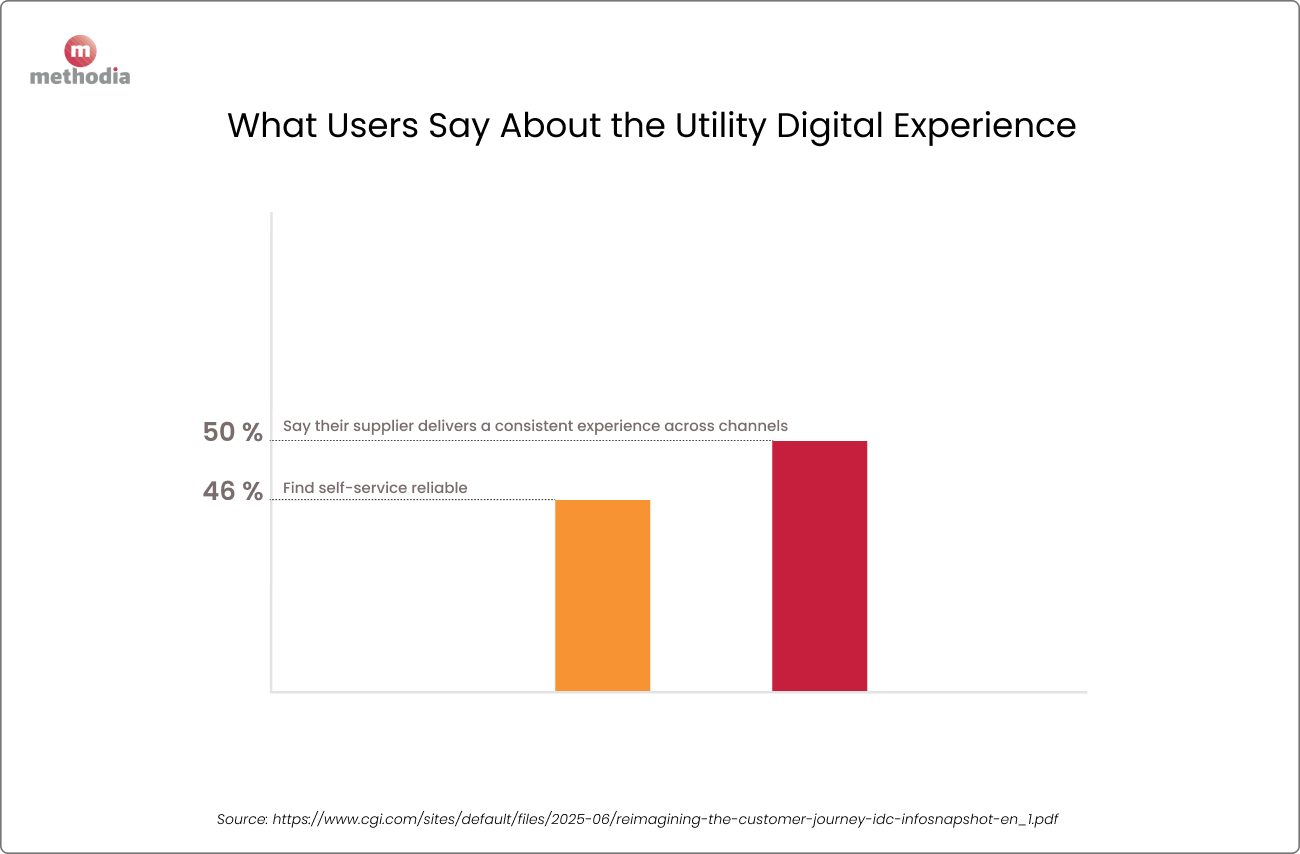
Before I continue, it’s worth looking at the reality behind all this. Research from IDC shows that fewer than 50% of energy consumers in Europe and the U.S. find it easy to complete basic tasks like switching suppliers or managing contracts. And only around half experience consistency across channels.
Legacy Infrastructure Is Only Part of The Problem
Yes, many utilities run core systems that were designed for a pre-digital world. Deloitte and others have noted the constraints this creates:
changes that should take days take months
processes are hardcoded
the cost of modification is high enough that it gets deferred indefinitely
But the response to build digital layers on top rather than replacing the core creates a different problem. The organization ends up with a modern front end while the underlying fragility remains.
Procurement Cycles and Organizational Inertia
Less often discussed, but just as significant: utility procurement cycles are long, conservative, and risk-averse. A decision to replace a billing system can take three to five years from a business case to go-live.
By the time the new platform is operational, the requirements have shifted. This is compounded by organizational structures where IT, operations, and customer teams work in silos, meaning that even when good technology exists, its implementation is undermined by the absence of a shared vision of what needs to change.
Billing Data Complexity and Fragmentation
Data from Ofgem and Citizens Advice consistently identifies billing as one of the leading causes of complaints in energy markets.
Obviously, billing is not a peripheral function. It is the primary recurring interaction between a utility and its customer. If the bill is wrong, confusing, or unpredictable, no amount of investment in self-service or proactive communication can recover the trust.
The bill is also where fragmentation becomes visible. Consumption data lives in meter data management systems. Tariff logic lives on billing platforms. Customer and contract data live in the utility CIS. When these systems don’t communicate cleanly, errors propagate downstream, and the customer gets the invoice at the end of the chain.
The Reactive Communication Problem
Beyond billing, the other consistent failure point we have observed is reactive communication. Most utilities still notify customers after something has happened: after a bill is issued, after an outage occurs, after a complaint has been raised. By then, the frustration is already there, and a notification becomes damage control rather than service.
McKinsey’s research points to what’s possible when analytics are used to shift this dynamic. Across industries, advanced analytics applied to customer service has been linked to satisfaction improvements of 10 to 20 percent, with cost-to-serve reductions of 20 to 30 percent in some cases. The mechanism matters: it is not communication alone that drives those outcomes, but the analytical capability underneath it.
It is about the ability to anticipate what a customer needs, across channels, before they feel the need to ask.
How to Actually Improve Customer Experience in Utilities
The utility companies that make genuine progress on customer experience tend to share a common approach: they fix operational foundations before improving customer-facing layers.
This sounds obvious, but in practice, it requires prioritizing work that is invisible to customers in the short term: data integration, billing validation, and event-driven automation over work that produces visible changes quickly.
The capabilities that consistently matter are:
Billing accuracy. Before any self-service or communication improvement, tariff logic must be correct, and invoicing must be validated before it reaches the customer.
A unified customer view. When customer, premise, meter, and contract data are aligned in a single environment, every interaction — whether handled by an agent or a self-service tool — becomes more consistent and more trustworthy.
Event-driven operations. Utility businesses are inherently event-driven: customers move, meters are read, and payments succeed or fail. Treating each event as a trigger for an automated, predictable response reduces manual intervention and error rates.
Meaningful use of smart meter data. Smart meters generate consumption data every 15 to 30 minutes. The opportunity is not in the volume of data but in its application: explaining consumption clearly, detecting anomalies before they become billing disputes, and enabling customers to make informed decisions.
Self-service is worth a separate note. Different studies show that nearly 70% of customers prefer to resolve issues independently when the tools work reliably.
However, industry-specific research shows that less than 50% of energy consumers in Europe and the U.S. find it easy to perform basic tasks such as switching suppliers and managing contracts. Only 50% say their supplier delivers a consistent experience across channels, and only 46% find self-service reliable.
The qualifier matters: self-service that produces errors or dead ends is worse than speaking to an agent, because it adds frustration to an already strained interaction.
On Technology: What It Can and Cannot Do
The industry is moving toward API-first, modular, event-driven architectures, and for good reason. These approaches make it easier to integrate systems, respond to change, and avoid monolithic platform failures of the past. Advanced analytics, when applied to clean and reliable data, can meaningfully improve customer outcomes.
The persistent mistake is treating technology as the primary variable. Generic CRM or billing platforms, not designed for the specific complexity of utility such as tariff structures, meter data relationships, and regulatory workflows, frequently require extensive customization that reintroduces the fragmentation they were meant to resolve. The result is a landscape of point solutions that each address one problem while creating integration challenges elsewhere.
Purpose-built platforms that unify billing, customer data, and operational workflows within a single environment have a structural advantage here: they address the root cause of disconnection rather than its symptoms. But even the right platform, implemented without the organizational alignment to use it well, will underdeliver.
Where Platforms Like Methodia Fit
Solutions like Methodia are designed to operate as an experience layer, but that’s not their real power.
Unlike conventional CX platforms, it doesn’t sit on top of broken financial logic and try to mask it. When Methodia participates in the experience layer, it does so with direct access to reconciled, deterministic financial outcomes.
That changes the nature of the experience entirely:
The interface is not querying multiple inconsistent systems
The answers are not subject to post-hoc correction
The interaction is grounded in the same logic that drives billing and revenue recognition
So yes, Methodia can power experience, but only because it is anchored in financial truth, not detached from it.
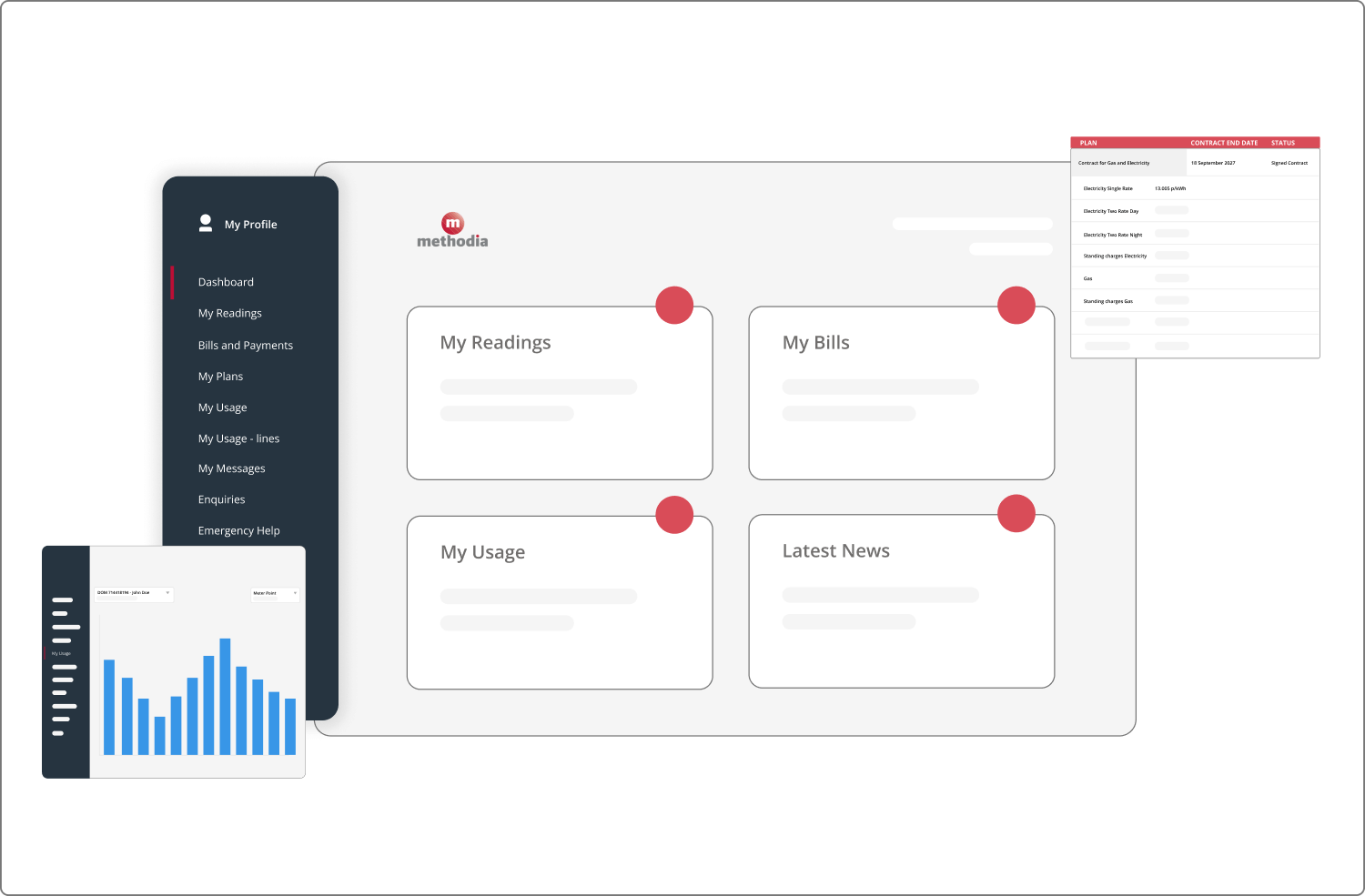
The real distinction is this.
Most experience layers in utilities are interpretation layers: they interpret, aggregate, and present data produced elsewhere.
Methodia, when used in that position, is not interpreting. It is executing and exposing the underlying financial logic itself.
That is a fundamentally different role.
The Uncomfortable Conclusion
Energy is no longer evaluated purely as a commodity. Customers assess their utility relationship each time they receive a bill, log into a portal, or call a service line. And they have extended the comparison set to include every digital experience.
The utilities that will close the gap are not necessarily the ones with the biggest technology budgets or the most sophisticated apps. They are the ones willing to prioritize operational integrity over interface aesthetics to accept that genuine customer experience improvement is slow, structural, and mostly invisible until it isn’t.
That is not a comfortable message. It is, however, a more accurate one than the industry tends to give itself.
The energy and utilities sector is entering one of the most transformative periods in its history. Rising demand, aggressive decarbonization targets, new customer expectations, and rapid technological innovation are reshaping how we plan, operate, and invest.
The players that will win aren’t the ones who simply build more capacity. They’re the ones who modernize their infrastructure, use data and digital tools to run smarter grids, accelerate the rollout of renewables and storage, and treat customers as active participants in the systems.
The pressure is real, but so is the opportunity. The choices energy and utility providers make in the next few years won’t just define their competitiveness, they’ll shape the future energy system we all depend on.
💡 Is your utility company prepared for the future? Now is the time to modernize and optimize for long-term success. Methodia is here to help.