
For years, utility customer experience (CX) was a simple formula: keep the lights on, send out accurate bills, and customer satisfaction would mostly take care of itself.
That world is gone.
Digitalization, new technologies, DER, EVs, price volatility, and extreme weather are increasing the number of “moments that matter,” while digital expectations keep rising.
Customers expect their utility to act less like a distant infrastructure provider and more like a responsive, data‑driven partner.
At the same time, regulators are tightening performance expectations, while extreme weather and price volatility keep pushing service teams to the limit.
So, utility customer experience is not a soft topic anymore.
In fact, innovation in the energy sector is being driven by the public. Over 30% of leaders admit that meeting customer needs is the second biggest reason they’re innovating.
The Reality Check: Utility CX Is Not Retail CX
It’s tempting to benchmark utilities against the retail, banking, or travel industry because customers do it in their heads.
But the fact is that utilities operate with constraints that most consumer brands will never face:
· Monopoly or quasi‑monopoly structures. In many markets, end customers can’t easily switch their distribution utility the way they switch streaming platforms.
· Heavily regulated pricing and service levels. Tariffs, disconnection rules, and service standards are set through regulatory processes, not marketing campaigns.
· Mission‑critical services. Outages and billing issues are not just inconveniences; they have real economic and safety implications.
At the same time, customer expectations are clearly shaped by experiences in other sectors.
European DSOs, for example, are increasingly viewed as market facilitators that must enable prosumers, EV adoption, and flexibility services all of which are inherently customer‑facing roles.
So, no, utility CX is not retail CX. But utilities are under pressure to provide retail‑grade experiences within a regulated, infrastructure‑heavy reality.
That’s simultaneously the challenge and the opportunity.
Key Challenges in Utility Customer Experience
I terms of customer experience most utility companies today face a similar set of obstacles:
You have to keep in mind that your systems represent these realities differently:
1. Complex, fragmented journeys
Connections, meter changes, supplier switching, rooftop PV, EV charging, billing disputes, and outage communications often run on different systems and teams. However, customers experience them as one relationship, but the backend does not.
2. Legacy systems and data silos
Many DSOs for example are mid‑journey in their utility digital transformation. Smart meter data, outage management, CRM, and billing often sit in separate stacks, making it hard to build a single customer view or automate journeys end‑to‑end.
3. Regulatory and tariff complexity
Tariff structures, subsidy schemes, and market rules are getting more complex, not less. Translating that into clear, simple customer communication and digital self‑service is a constant challenge.
4. Rising contact volumes and cost pressure
As the energy transition accelerates (DER, EVs, heat pumps), volumes of queries and service interactions grow. At the same time, regulators and boards expect utilities to reduce cost‑to‑serve and prove operational efficiency.
5. Trust and transparency during crises
During storms, price spikes, or grid constraints, utilities become highly visible. How proactively and transparently they communicate in those moments strongly shapes long‑term trust.
A Practical Definition of Utility CX
In a utility context, customer experience can feel abstract. A useful working definition is:
Utility CX is the cumulative perception customers have of their utility across every touchpoint, from new connection to outage to billing, driven by how easy, transparent, and reliable those interactions are.
Practically, that means CX is shaped by:
- Core service performance – reliability, power quality, billing accuracy, restoration times.
- Interaction quality – how quickly and accurately issues are resolved, via which channels.
- Information quality – how understandable, transparent, and proactive communications are.
- Empowerment – the degree to which customers can self‑serve, understand, and manage their usage, costs, and choices (e.g., DER, tariffs, flexibility programs).
This is why CX cannot sit only in marketing or the call center. For utilities, it is a cross‑functional operating model issue:
- – how assets are planned and maintained
- – how outages are managed
- – how data flows
- – how front‑line teams are equipped
The Trends Shaping Utility Customer Experience
Several structural trends are redefining what good looks like in utility CX context. Four are particularly important.
1. CX Is Becoming a Platform Capability (not a just service department initiative)
The Utility Innovation Survey 2025 is a a useful reality check here. Even in a year where grid modernization (71%) dominate innovation agendas, customer experience & engagement platforms still rank in the top tier at 19%.
In other words, roughly 1 in 5 utility leaders are explicitly prioritizing CX technology, despite being squeezed by infrastructure and compliance demands.
What’s even more interesting is the shift versus last year: customer service/engagement was 33% in 2024, and it drops to 19% in 2025. That doesn’t mean CX matters less. It usually means CX is being absorbed into the bigger transformation programs: digital transformation, automation, AI.
2. AI‑Driven Service and Operations
AI in utilities is a topic big enough for a separate article. So I’ll keep this section tight and focus on what AI actually changes for customer experience.
A recent industry survey, shows that AI is already a strategic focus for 96% of utility innovation leaders and their companies are deploying AI to enhance operational efficiency and customer engagement.
It is obvious that AI is moving rapidly from experimentation to production in utilities, supporting both operational excellence and better customer experiences.
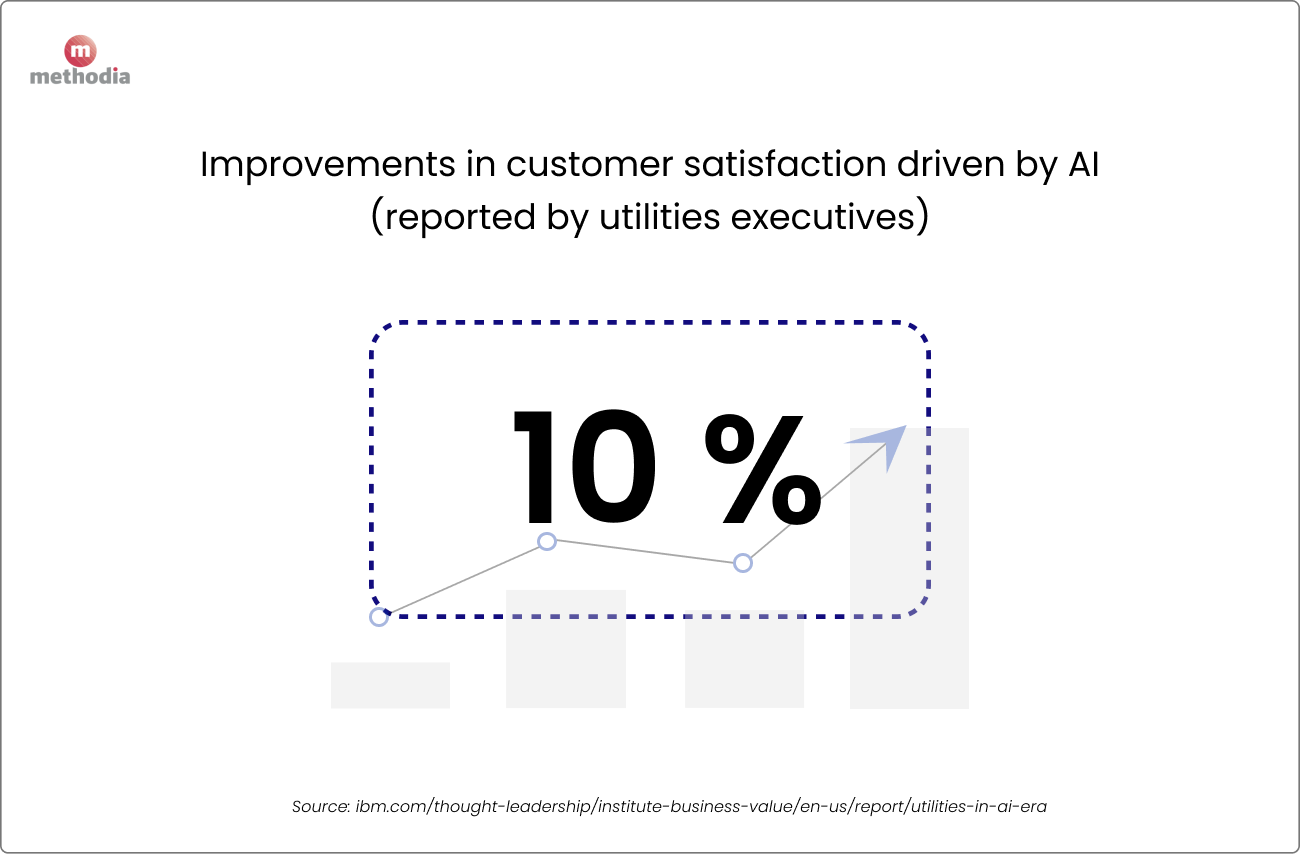
When it comes to how AI is driving measurable improvements, utilities executives report a 10% improvement in customer satisfaction.
And last but not lease, the most direct CX investments, when it comes to AI integration plans over the next years include:
– AI-powered energy efficiency recommendations for customers
– customer service chatbots/virtual assistants
– data analysis & business intelligence
3. Proactive, Omnichannel Communication
Customer communication in utilities is shifting from multi-channel to truly omnichannel, and the difference is big.
Apps, portals, chatbots, etc. are gradually merging into one connected environment where customer requests are handled digitally by default, with consistent context carried across channels.
The result is a clear operating model shift: routine questions and standard service requests move to self-service and automation.
Recent research shows that the vast majority of DSOs (more than 80%) already run personal web portals.
Also nearly half of surveyed companies report strong growth, with active users up 200–300%.
4. Automation: Digital-by-Default Service
Automation is becoming the quiet engine behind modern utility CX. Not just a buzz words, but the operational automation that makes customer service digital by default, consistent, and fast.
In practice, utilities are automating the high-volume, repeatable parts of service: routing, status updates, data validation, standard request handling, etc.
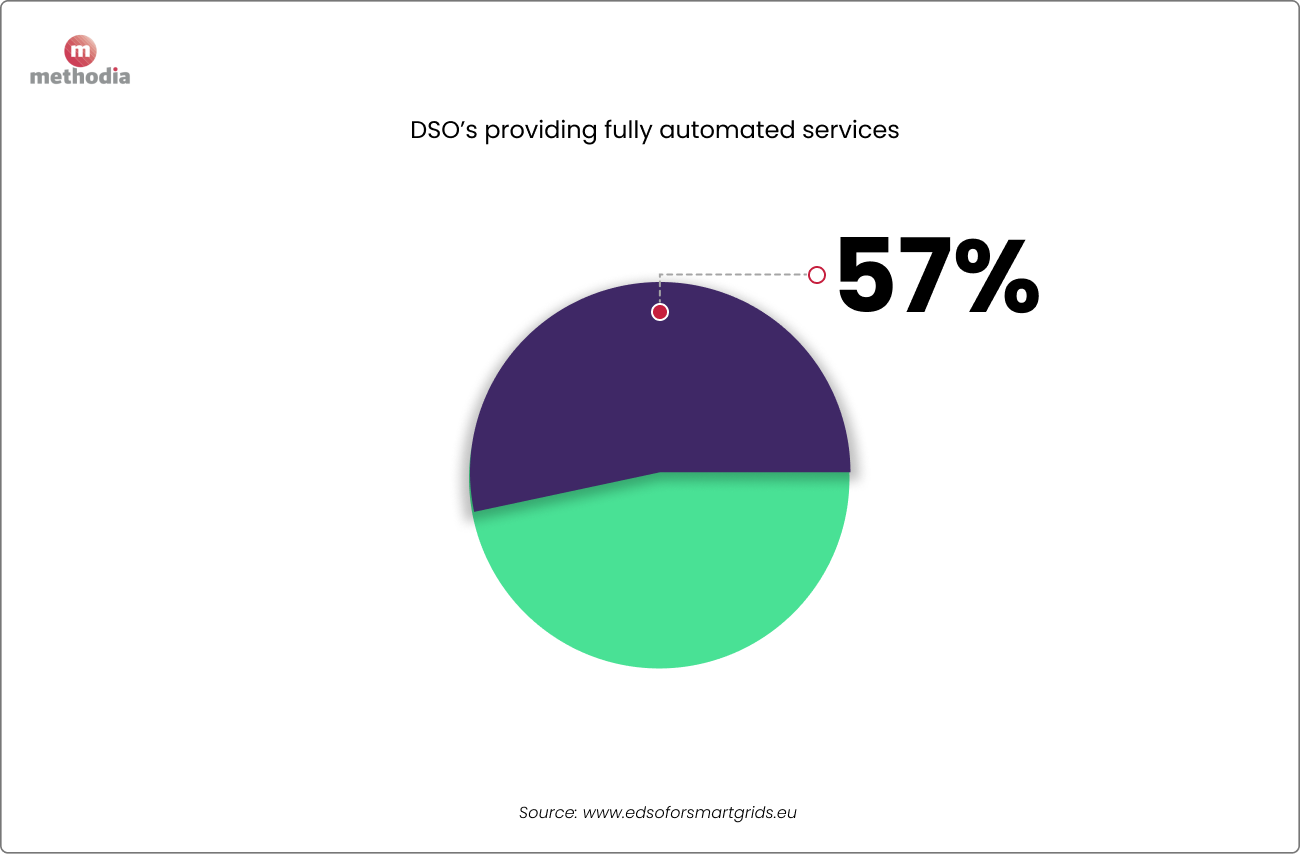
The data shows this shift is already underway: 57% of companies provide fully automated services accessible through an app, chatbot or web portal.
At the same time, process automation and operational efficiency are a top innovation priority for utilities and energy companies, ranking third after digital transformation and grid modernization.

5. Data‑Driven Personalization
When it comes to customer engagement, there are 3 pillars of UX: Automation, Convenience and Personalization.
Personalization in utilities doesn’t mean flashy marketing. It means using customer and grid data to make interactions more relevant, more proactive, and easier to act on without crossing privacy or regulatory lines.
The shift starts with a simple truth: most bad CX in utilities comes from customers not understanding what’s happening (usage changes, tariff impacts, outages, connection status) and not knowing what to do next.
This is why it is not a surprise that two of the areas where AI has the biggest impact are:
- – AI-Powered Energy Efficiency Recommendations for Customers
- – Personalized Marketing
And to strengthen the thesis, I want to mention that and HBR article on the topic defines 3 stages that are critical for energy companies to fortify their position: providing value-added products and services; providing ultimate CX and Personalization.
Case Study: Turning CX Into an Advantage
A UK business energy supplier came to us with a clear promise to its customers: make energy simple for businesses through cost-effective fixed tariffs, clear out-of-contract rates, and easy online access to services. But as the market became more uncertain and their operations grew, they hit a limit. The manual work behind core journeys, especially onboarding and meter reading submissions, couldn’t scale without driving up cost-to-serve and slowing response times.
They turned to Methodia because they needed an automated, end-to-end utility management solution combined with fully managed services, something that could handle higher customer volumes while streamlining more business processes across the customer lifecycle.
Within months, the results were clear:
- – We helped reduce calls and emails to support agents by 50% related to meter reading submissions.
- – We enabled a faster, easier enrollment experience, reflected in a 421.2% increase in self-service portal users within six months.
- – Over the first year, the supplier increased customer acquisition, with up to 20% more customers signing each month.
The takeaway: when self-service is backed by true customer experience, automation and integrated operations, not just a portal, retailers can grow sustainably while improving customer experience and reducing pressure on service teams.
Final Thoughts
Customer experience in utilities is no longer about making the call center a bit nicer. It is about giving customers clear, proactive, and trustworthy information and empowering them to participate actively.
The reality is that utility CX will always be different from retail CX, regulated, infrastructure‑heavy, risk‑sensitive. But with the right combination of AI, digital platforms, and data‑driven journeys, utility companies can close much of the expectation gap, while also improving cost‑to‑serve and regulatory performance.
💡 Is your utility company prepared for the future? Now is the time to modernize and optimize for long-term success. Methodia is here to help.

