

Why Utilities Need a Different Kind of CRM
In my experience, most off-the-shelf CRMs are designed for traditional B2B or B2C sales organizations, assuming simple product catalogs, short sales cycles, and minimal regulatory constraints. And don’t get me wrong, there are amazing CRM tools.
Utilities, however, operate in a more complex environment. They operate in regulated markets, with operational complexity and high-volume, low-margin customer bases. Relationships are meter-based, requiring precise alignment of consumption, contracts, and sites.
Here is the thing.
For most utilities and energy retailers, the tech stack has grown around internal processes: a billing engine, a meter data management system (MDMS), a CRM system, etc.
On paper, this setup works. In reality, customers don’t experience these as separate systems. They interact with you through a bill that makes sense or doesn’t, a service interaction that solves their problem or doesn’t.
This is why the best CRM software for utilities isn’t just a generic CRM with an industry label. It’s a platform designed to understand utility-specific data models, market roles, and the relationships between customers, connection points, meters, and products.
Before I jump to the next section, let me share this with you: research from Nucleus Research found that organizations see an average return of $8.71 for every dollar invested in CRM technology.
So, a powerful CRM tool is an essential component of any company’s technology stack. However, the question is, “Is any CRM okay for any industry?”
Generic CRM vs Utility-Specific CRM Platforms
Before I jump into the specific solutions, I want to mention that utilities often evaluate both generic CRM platforms and software designed specifically for the energy and utilities sector. And while generic systems provide strong customer management tools, they often require significant customization to support utility operations.
The table below highlights some of the key differences.
| Capability | Generic CRM Platforms | Utility-Specific CRM Platforms |
|---|---|---|
| Customer data model | Designed for general sales and customer service workflows | Designed for utility customers, service points, and supply contracts |
| Billing integration | Usually requires custom integration with billing systems | Often includes built-in integration with CIS and billing platforms |
| Meter-to-cash support | Typically not supported natively | Supports customer lifecycle processes connected to billing and meter data |
| Contract and service management | Focused on sales pipelines and deal management | Supports energy supply contracts, service agreements, and renewals |
| Utility operational workflows | Requires customization for processes like change of tenancy or meter requests | Includes workflows designed for utility operations and regulatory requirements |
| Integration with operational systems | Integration possible but often complex | Designed to connect with meter data, billing systems, and utility portals |
| Implementation effort | Often requires significant configuration for utility use cases | Usually faster to deploy for utilities due to industry-specific functionality |
Best CRM Software for Energy and Utilities Sector
At first glance, there’s no shortage of CRM platforms on the market. Many solutions, such as HubSpot, Pipedrive, and Monday, for example, are widely used across industries and often claim to support utilities as well.
But as I wrote above, the reality is that utilities operate very differently from most other sectors.
Utility and power companies must manage complex billing structures, meter data, regulatory processes, switching events, service connections, and large volumes of operational data. Customer service teams often need to see billing history, meter readings, contracts, payment status, and service requests in one place.
This is why many utilities choose CRM solutions built specifically for the utility industry.
Platforms designed from the ground up to work with billing engines, meter data management systems, market communications, and regulatory workflows.
Methodia Utility Suite
Methodia is a modular utility management platform designed specifically for the energy and utilities sector. It combines CRM capabilities with broader operational functions such as billing, asset management, self-service portals, and market operations.
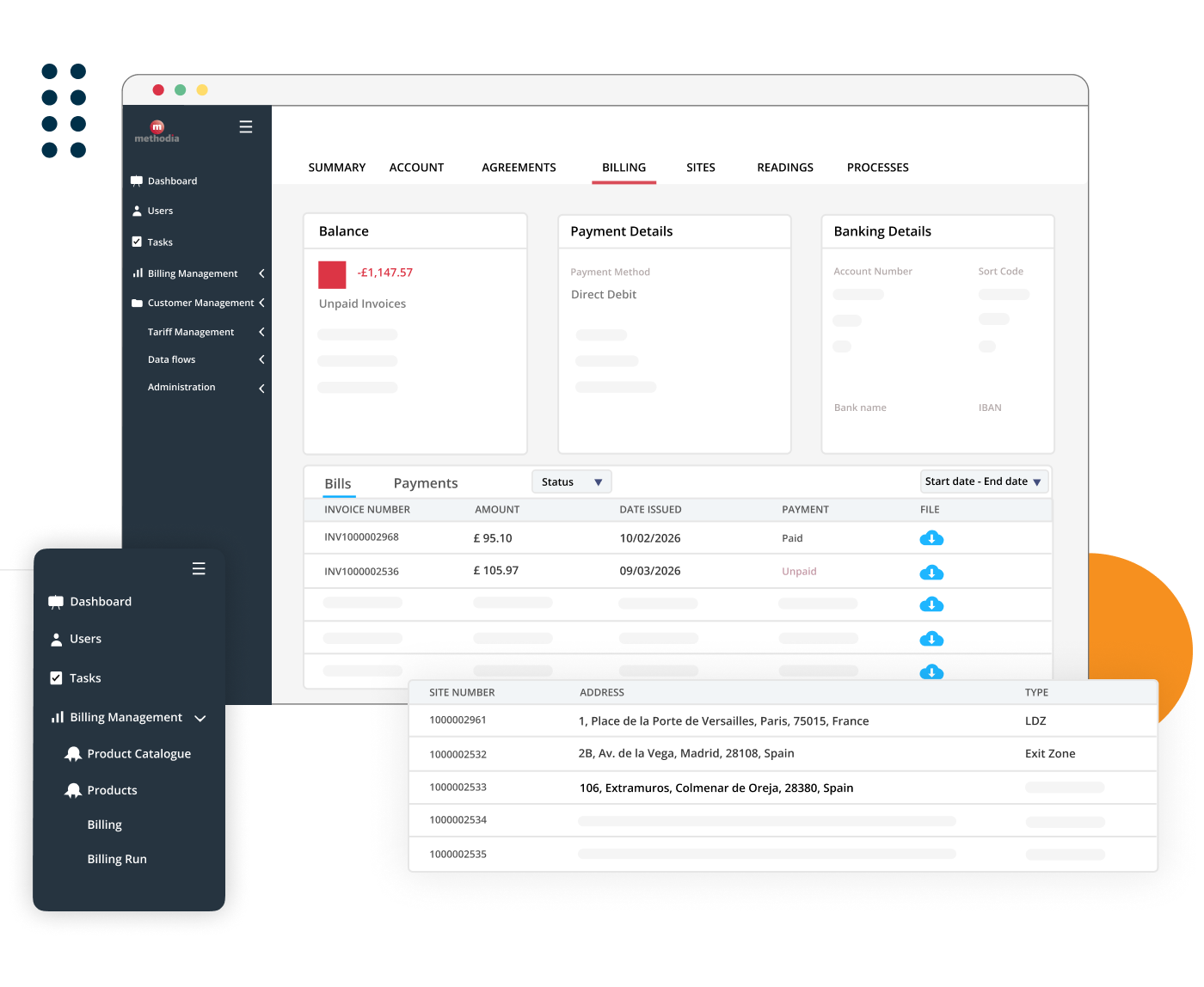
The CRM module allows utilities to manage customer interactions while connecting directly to billing, meter data, and operational workflows.
The platform focuses on delivering a unified operational environment where customer service teams, operations teams, and management share the same data and processes.
Because the platform is modular, utilities can implement CRM alongside other capabilities such as billing, asset management software, and analytics.
Best for: utilities, energy retailers, and multi-utility providers looking to manage the full customer lifecycle, from onboarding and service requests to billing and operations, within a modular SaaS platform.
Salesforce Energy & Utilities
Salesforce Energy & Utilities adapts the Salesforce platform for the utilities industry. It provides customer lifecycle management, case management, field service integration, and omnichannel engagement tools.
Usually, energy companies use Salesforce primarily as a customer engagement layer, integrating it with top utility billing platforms and operational systems such as CIS or meter data management platforms.
The strength of Salesforce lies in its ecosystem and extensibility. Utilities can integrate customer analytics, marketing automation, and service workflows within the same environment.
Best for: utilities that want a highly flexible CRM platform integrated into a broad technology ecosystem.
SAP Service Cloud
SAP Service Cloud is SAP’s customer service and CRM platform, designed to support complex service operations. Utilities often use it as part of the broader SAP utilities ecosystem alongside other platforms.
The platform provides capabilities such as customer interaction management, service request workflows, knowledge management, and omnichannel customer support.
Because many utilities already operate core systems within the SAP ecosystem, SAP Service Cloud often becomes the natural choice for managing customer service interactions and support processes.
Best for: utilities already running SAP environments and seeking an integrated customer service platform.
Oracle Utilities Customer Service
Oracle UCS is one of the most widely deployed CIS platforms in the utilities industry. It combines customer management with billing and meter-to-cash operations.
Unlike traditional CRM platforms, Oracle Utilities Customer Service integrates customer data directly with billing processes, tariffs, and consumption data.
The platform is widely used by large utilities operating complex portfolios of electricity, gas, or water services.
Best for: large regulated utilities that want CRM functionality integrated with CIS and billing systems.
Itineris UMAX
Itineris UMAX is a cloud-based platform built specifically for utilities and energy suppliers. The platform combines CRM, CIS, and billing capabilities in a single environment.
Built on the Microsoft ecosystem, UMAX integrates with Microsoft Dynamics technologies while focusing on utility-specific operational workflows such as meter-to-cash, service requests, and contract management.
Its strength lies in being purpose-built for utilities rather than adapted from generic CRM systems, making it easier to support industry-specific processes.
Best for: utilities seeking a modern CIS and CRM platform designed specifically for the energy sector.
HansenCX
HansenCX is a customer engagement platform designed specifically for utilities. It focuses on managing the entire customer lifecycle, including onboarding, service requests, billing interactions, and digital utility customer experience.
Utilities often deploy HansenCX as part of a broader operational platform, integrating it with billing systems and CIS environments.
The platform emphasizes omnichannel customer interactions and digital engagement capabilities.
Best for: utilities focused on improving customer experience and service operations.
Kraken
Kraken is a cloud platform originally designed for retail energy suppliers. It combines CRM functionality with billing and operational workflows in a unified system.
The platform is particularly known for its ability to automate customer operations and support high-volume retail energy environments.
Kraken has been widely adopted by competitive energy retailers looking for modern cloud-based operational platforms.
Best for: energy suppliers and retail utilities managing large customer portfolios.
How to Choose the Right CRM for a Utility
As I already wrote, while many CRM platforms provide basic customer management capabilities, utilities often require specialized functionalities that connect customer interactions with contracts, billing processes, and operational workflows.
Below are some of the key areas to consider.
Unified Customer Lifecycle Management
A utility CRM should provide a complete view of each customer, including personal information, account relationships, and service locations.
Key capabilities include:
- Creation and management of customer profiles for both domestic and business customers
- Management of customer status across the lifecycle (lead, opportunity, active client)
- Storage and management of multiple addresses, including billing, site, and historical addresses
- Assignment and management of customer contacts with roles such as billing contact, primary contact, or meter-point contact
- Selection of preferred communication channels such as email, SMS, phone, or mail
- Attachment and storage of customer documents, such as Letters of Authority or contracts
Contract and Service Agreement Management
Utilities often manage multiple contracts per customer across different services or supply points. A CRM platform should support the full lifecycle of these agreements.
Important capabilities include:
- Creation and management of multiple customer contracts
- Support for contract start and end dates, products, and pricing structures
- Ability to sign, renew, terminate, or modify contracts
- Maintenance of contract statuses such as draft, active, declined, or terminated
- Support for processes such as a change of tenancy or ownership
Billing and Financial Information Management
Because CRM interactions often relate to billing inquiries, the platform must maintain close integration with billing and payment systems.
Core functions typically include:
- Creation and management of billing contacts
- Management of payment details and payment terms
- Storage of banking and billing information
- Synchronization with billing systems to ensure accurate financial data
Customer Engagement and Marketing
Utilities increasingly use CRM platforms to manage communication with customers and deliver targeted notifications and campaigns.
Relevant capabilities include:
- Creation of marketing templates and automated notifications
- Sending email campaigns and service communications
- Management of promotions, discounts, or service offers
- Tracking communication history, including email delivery status and recipients
- Sending operational communications such as meter read reminders or billing notifications
Operational Workflow and Process Management
Utilities rely on structured processes to manage customer operations efficiently. CRM platforms should support automated workflows for common service scenarios.
Typical examples include:
- Contract cancellation workflows
- Change of tenancy processes
- Data imports and operational process automation
- Task management related to customer service or operational requests
Integration with Utility Platforms
CRM cannot operate in isolation within a utility environment. It must connect with other operational systems to provide a complete view of customer and service activities.
Important integrations may include:
- Customer self-service portals
- Energy broker software platforms
- Customer switching platforms
- Operational dashboards and analytics tools
- Central client databases
- Direct market integration for data exchange
The energy and utilities sector is entering one of the most transformative periods in its history. Rising demand, aggressive decarbonization targets, new customer expectations, and rapid technological innovation are reshaping how we plan, operate, and invest.
The players that will win aren’t the ones who simply build more capacity. They’re the ones who modernize their infrastructure, use data and digital tools to run smarter grids, accelerate the rollout of renewables and storage, and treat customers as active participants in the systems.
The pressure is real, but so is the opportunity. The choices energy and utility providers make in the next few years won’t just define their competitiveness, they’ll shape the future energy system we all depend on.
💡 Is your utility company prepared for the future? Now is the time to modernize and optimize for long-term success. Methodia is here to help.