
Why Is Asset Management Now a Strategic Priority for Utilities?
If I have to be honest the full question will sound like this: Why is asset management now a strategic priority for utilities, more than ever?
And the answer is simple, because the pressure on them is higher than ever.
For decades, many utilities relied on manual inspections, scattered spreadsheets, and reactive maintenance to keep systems running. That approach simply can’t keep up anymore.
This is why enhancing asset performance is one of the 5 pillars of digital transformation in utilities.
On the other hand, recent research shows that grid modernization tops the list of innovation priorities.
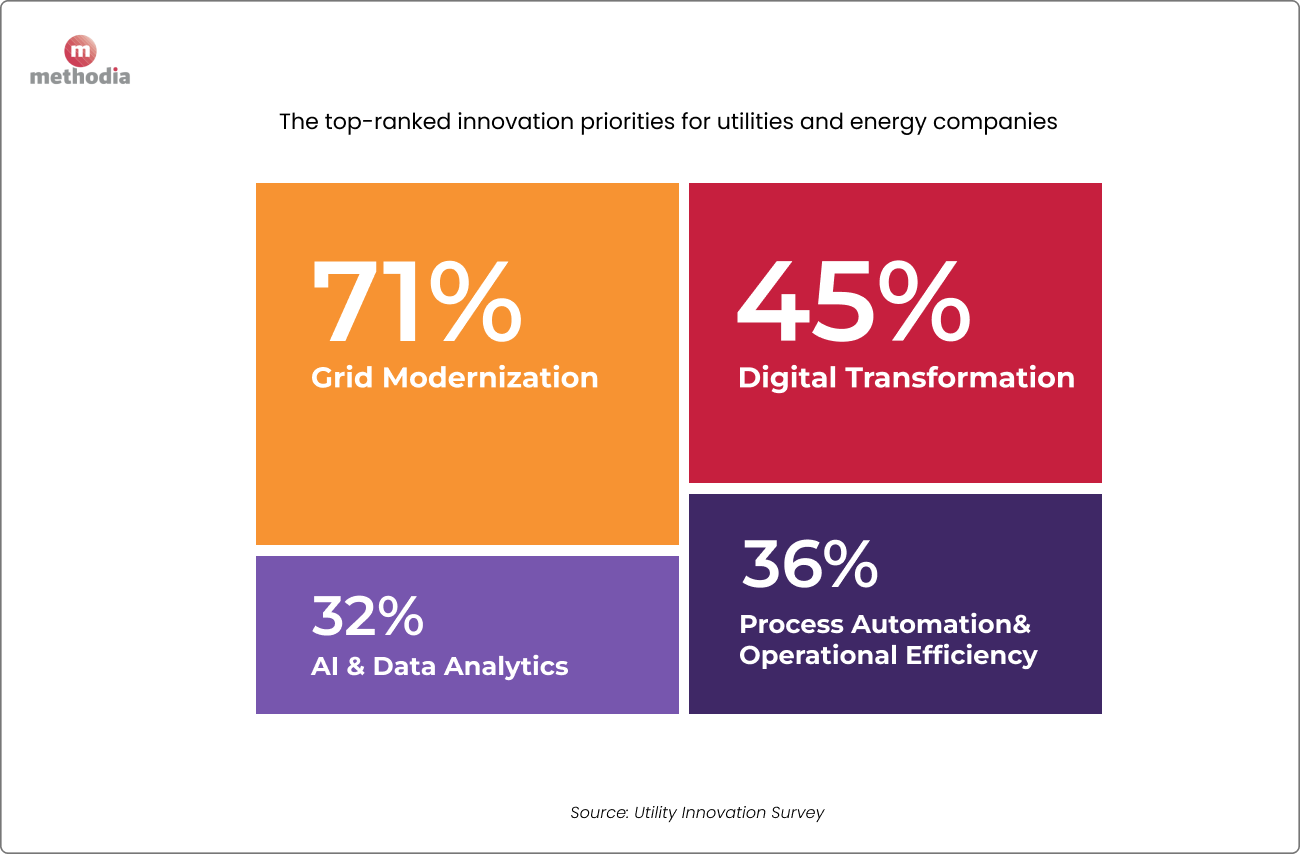
What is the connection?
A modern grid is automated, digital, and data-driven. You can’t automate or optimize something you don’t fully understand. And utility asset management software provides a complete real-time picture.
It is no coincidence that IoT investments mark massive growth in the utility industry. And also technologies like digital twins take central place, simply because modern grid operations are impossible without live data, accurate models, and predictive intelligence.
If you are still not convinced of the importance of utility asset management systems, I have to add that according to a EY research only 15% of the surveyed companies don’t use EAM systems or have an in-house developed system.
What Are the Top Asset Management Software for Utilities?
Modern utility asset management software centralizes everything you need to manage critical infrastructure across its entire lifecycle. In practical terms, it provides:
- – a single asset registry
- – real-time condition monitoring
- – smarter maintenance planning
- – predictive analytics
- – risk-based decision-making
- – better communication between field and office
Methodia EAM for Utilites
Methodia is purpose-built for utilities and power companies, not a generic EAM reassembled for the industry. It’s designed to help utilities visualize, track, and control all company assets in one place, with comprehensive asset data that supports risk mitigation and maintenance cost control.
It’s a platform proven at scale, with more than 50 million assets managed across global utility operations, underscoring its maturity and ability to support high-volume, high-complexity environments.
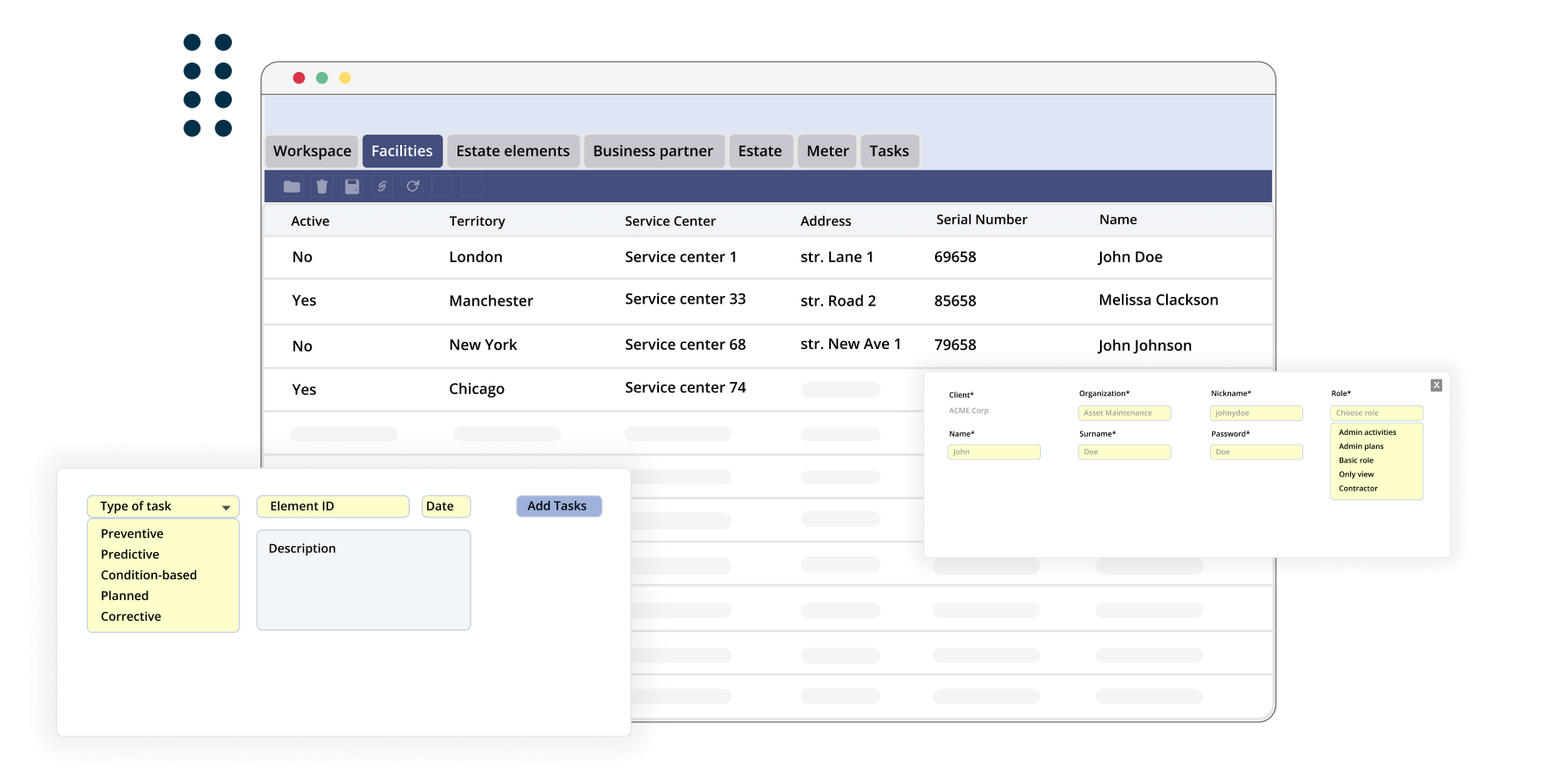
The platform emphasizes high configurability and usability across roles, from executives who need portfolio-level visibility to field teams who need fast, clean screens to log work and inspections. It’s mobile-friendly out of the box, so asset information, maintenance tasks, and inspections can be accessed and updated in real time in the field.
As part of Methodia’s broader Utility & Telecom Suite, the EAM module can connect tightly with billing, customer, and operations processes, which is especially valuable for utilities that want a single operational backbone rather than a pile of point solutions.
Best for: utilities that want an EAM tailored to energy/utility workflows and tightly integrated with customer and billing operations.
Standout features: purpose-built for utilities, comprehensive asset data, mobile access, strong fit with retail energy and multi-utility environments, GIS module, SCADA component.

IBM Maximo Application Suite
A long-standing leader in asset management, Maximo is known for its depth and reliability in large utility environments. It’s a unified asset and facilities lifecycle platform that combines EAM, APM (asset performance management), and monitoring into a single suite. It helps energy and utility companies shift from reactive to proactive operations with condition-based monitoring and analytics that detect anomalies, predict failures, and prevent outages before they occur.
For utilities specifically, IBM highlights Maximo as a tool for grid modernization, renewable integration, and regulatory compliance. It supports utility-specific needs such as transmission and distribution assets, smart meter management, and linear network infrastructure.
Best for: large electric, gas, and water utilities with complex networks and strong reliability/compliance requirements.
Standout features: advanced predictive analytics, digital twins, strong utilities-specific capabilities, and deep support for grid assets.
SAP EAM
SAP’s Enterprise Asset Management is positioned as an end-to-end asset lifecycle solution, from planning and procurement to operations, maintenance, and retirement. It focuses on reducing downtime, improving ROI, and giving organizations a real-time view across plants, networks, and fleets.
In the utilities space, SAP explicitly targets utilities and service organizations, combining EAM with real-time analytics, geo-asset management, and integration with SAP S/4HANA. The utilities portfolio is pitched to help companies run “more sustainably, safely, and profitably” through real-time visibility and integrated processes across operations, finance, and supply chain. Roadmap content for utilities shows continued investment in predictive maintenance, integration with GIS, and better analytics for maintenance orders.
Best for: utilities already invested in SAP (ERP, finance, supply chain) looking to standardize on one stack.
Standout features: deep integration with S/4HANA, strong lifecycle asset management, utilities-specific innovations, and powerful analytics.
Oracle EAM
Oracle Utilities Work and Asset Management (WAM) built specifically for energy and water utilities, covering the full asset lifecycle with capabilities to increase maintenance efficiency, predict and prevent problems, extend asset life, and reduce costs, with both cloud and on-premise deployment options.
Oracle also talks about capital asset lifecycle management for utilities tying long-term planning, project execution, and asset operations together, especially in the context of safety, reliability, and carbon neutrality goals.
Best for: utilities that want tight links between asset management, capital planning, and the rest of the Oracle ecosystem (billing, utility CIS, finance).
Standout features: strong linear asset support, full asset + work lifecycle coverage, robust capital planning and compliance focus.
Salesforce Energy & Utilities Cloud
Salesforce Energy & Utilities Cloud is not a pure EAM, but it’s very relevant where asset management overlaps with field work, customer interactions, and service operations. It’s essentially a utilities-specific layer on top of Salesforce CRM, with prebuilt processes for energy/utility use cases.
In utilities, Salesforce positions this stack (Energy & Utilities Cloud + Salesforce Field Service) as a way to get complete visibility into service operations and assets, from meter installations to asset maintenance and vegetation management. It’s used to manage work orders, schedules, and mobile crews, while keeping all the data lined up with customer and account information. Third-party experts highlight its strength in field service management and appointment scheduling, where you combine E&U Cloud with Field Service to orchestrate field work and asset-related interventions efficiently.
Best for: utilities that prioritize field service excellence and want asset-related work tightly integrated with CRM and customer processes.
Standout features: strong field service management, customer-centric view of asset work, mobile workforce tools, and integrations with CIS/Utility billing.
Zapium
Zapium is a maintenance and asset management platform with a clear focus on ease of use and fast adoption. Its core pitch is to cut downtime and maintenance costs by automating work orders, preventive maintenance, asset tracking, and technician dispatch through a modern, real-time interface.
For utilities and energy companies specifically, Zapium offers a dedicated utility and energy asset management solution that covers asset profiling, maintenance scheduling, and oversight of critical physical assets such as infrastructure components, meters, and maintenance tools. They emphasize predictive maintenance, operational reliability, and compliance with environmental regulations as key outcomes, positioning Zapium as a way to transform utility operations while boosting sustainability.
Best for: utilities (including smaller or mid-sized ones) looking for a cloud, modern, relatively lightweight platform with strong maintenance and asset workflows.
Standout features: intuitive UI, IoT-driven maintenance positioning, strong preventive maintenance and work order automation, utilities-specific asset scenarios.
SafetyCulture (iAuditor)
SafetyCulture (formerly iAuditor) is not a full EAM, but it’s very strong as an operational layer on top of asset management: inspections, audits, incident reporting, and frontline workflows. It’s a mobile-first platform that lets teams digitize checklists, capture photos/videos, log hazards, assign corrective actions, and generate reports instantly.
In recent years, SafetyCulture has added an Assets capability: teams can keep a digital asset register, track asset histories, schedule recurring inspections and maintenance, and link inspection results directly to asset records. That makes it a useful complement for utilities that want to tighten inspection quality and documentation without ripping out an existing EAM. It’s widely used across safety-critical industries to standardize inspections and keep audit trails clean, and the mobile UX is one of its biggest selling points for field adoption.
Best for: utilities that want to digitize inspections, safety processes, and asset checks quickly, possibly alongside another core EAM.
Standout features: powerful mobile inspections, digital asset registers, great audit trails, and fast frontline adoption.
The Future Belongs to Forward-Thinking Utilities
It’s clear that modern utility asset management software is no longer optional. It’s one of the most strategic investments a utility can make.
Whatever direction you take, don’t rush the decision. Shortlist your top candidates, request hands-on demonstrations, and involve both operations and field teams in the evaluation. Think not only about the assets you manage today, but about the grid you’ll be responsible for in five years. The right asset management system isn’t just a tool, it’s the foundation for long-term operational resilience.
If you’d like to explore how Methodia can support your asset management strategy, we’d be happy to guide you through a tailored demo whenever the time is right.
💡 Is your utility company prepared for the future? Now is the time to modernize and optimize for long-term success. Methodia is here to help.


