
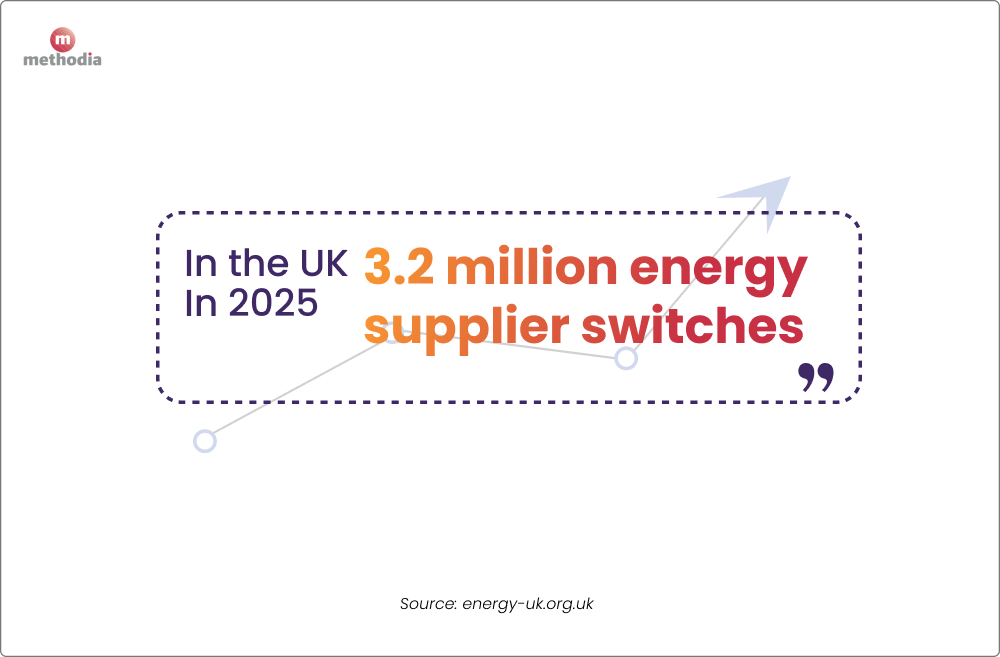
Utility quoting becomes especially important in liberalized markets, where suppliers compete more directly for customer acquisition and retention. For example, a report shows that in the UK more than 3.2 million energy supplier switches occurred in 2025, and this describes a price-sensitive customer base that responds strongly to tariff changes and competitive offers. In that kind of market, slow or inaccurate quoting is not just inefficient. It is commercially dangerous.
From what we have seen, utilities do not struggle with quoting because they lack document templates. They struggle because pricing is not simple, approvals are rarely linear, and the information needed to produce a quote often lives across different systems and departments, such as sales, pricing, billing, CRM, etc. That is exactly where utility quoting software becomes valuable.
Generic quoting tools can help teams create polished sales documents. But utilities and energy suppliers usually need more than document generation. Usually, when clients come to us they are trying to find a controlled way to build quotes around tariffs, usage assumptions, contract terms, discount rules, approval workflows, and downstream billing realities.
So let’s see what utility quoting software actually is.

What Is Utility Quoting Software?
A simple definition
Utility quoting software helps utility providers, energy suppliers, and related service teams create accurate commercial quotes faster and with less manual effort. In practice, it brings together pricing logic, product and tariff rules, contract structure, approvals, and customer data so that quotes are produced consistently.
How utility quoting software differs from generic quoting tools
A generic quoting tool usually focuses on creating and sending quote documents. That can work for straightforward products with simple pricing. Utility sales, however, often involve variable charges, fixed charges, contract terms, site-specific conditions, broker involvement, and internal controls.
Why quoting gets more complex in utilities
In utilities, the quote is rarely just a sales artifact. It can influence contract setup, customer onboarding, billing configuration, revenue assurance, and service delivery. A quote may need to account for tariff structures, standing charges, usage bands, non-commodity components, contract duration, pricing governance, and market-specific rules.
Why Utilities Need Specialized Quoting Software
For utility companies, the reality is that a quote may not be built around a single product and a single customer record. It may involve multiple sites, different usage patterns, contract conditions, and a mix of pricing logic that must be handled together in one commercial process. That is where regular quoting tools often fall short.
One of the clearest differences between regular quoting software and utility CPQ is multi-site quoting. Utilities often need to price and manage opportunities that span multiple locations, usage profiles, and contract conditions, which requires more than a standard quote builder.
Utility CPQ tools are built to manage that complexity. They support quote creation across multiple locations, handle more complex commercial structures, and help sales teams keep pricing, approvals, and downstream execution aligned.
That is especially important for brokers, business energy suppliers, and utilities selling to larger commercial customers, where a single deal may cover many sites rather than one simple service point.
Key Features to Look for in Utility Quoting Software
Tariff and pricing rule management
A credible utility quoting software platform should support fixed and variable pricing structures, contract terms, standing charges, usage assumptions, and other pricing components without forcing teams back into spreadsheets.
Product and contract configuration
The software should help users build quotes around real utility offers, not just generic line items. That includes configurable products, contract options, and offer logic that reflects how the business actually sells.
Approval workflows and discount controls
For utilities, pricing discipline protects both margin and governance. The right solution should make approvals visible, structured, and easy to enforce.
CRM, billing, and operational integration
This is one of the most important criteria. The best utility quoting software should not operate as a standalone quote generator. It should connect to energy CRM and, where relevant, to customer, contract, utility billing, or revenue workflows so the approved quote does not have to be recreated manually later.
Quote document generation
Document creation still matters. It should sit on top of sound pricing and workflow logic rather than replace it.
Audit trails, security, and compliance support
Utilities operate in environments where accountability matters. A good solution should provide version history, approval visibility, and control over who can change pricing or terms.
Best Utility Quoting Software Tools and Solutions for 2026
Not all quoting tools solve the same problem. Some are built mainly to help sales teams create and send quote documents faster. Others support broader quote-to-cash workflows with pricing rules, approvals, contracting, and downstream billing logic.
For utilities, the best fit is usually the solution that can handle pricing complexity, contract structure, workflow control, and integration with energy CRM, billing, and operational systems, not just generate a polished PDF quote.
Methodia Utility Suite
Methodia is a strong fit for utilities and energy suppliers that need quoting connected to a broader operational workflow rather than treated as a standalone document step.
It supports automated energy quoting, multi-quote generation, pricing-rule configuration, agreement creation, contract renewals, and quote management for energy suppliers and brokers.
That is particularly important in utility sales, where multi-site quoting and more complex commercial structures often separate true utility CPQ from regular quoting software.
Salesforce Revenue Cloud
Salesforce Revenue Cloud is a good option for utilities that want quoting inside a broader industry CRM environment. It combines utility-focused workflows, automation, and integration capabilities that help connect quoting with customer data, service processes, and enterprise-scale operations. It is especially relevant for utilities that want quoting to sit within a bigger customer and revenue management ecosystem.
Hansen CPQ for Utilities
Hansen CPQ is one of the clearest purpose-built solutions in this category. It supports omni-channel quote and order capture for utilities selling both standardized and more complex offerings. The solution can break sophisticated enterprise propositions into manageable sub-components and tasks. Hansen CPQ can be connected to supporting sales systems and processes, like Microsoft Dynamics 365, Salesforce and Oracle.
POWWR Sales360
POWWR Sales360 is especially relevant for supplier and broker-led energy sales. It is built to help teams generate custom quotes fast while supporting usage-based pricing, automated contracting, and smoother sales execution. It is a strong fit for organizations where speed, broker workflows, and energy-specific quoting requirements matter most.
Picking the Utility Quoting Software That Fits Your Needs
Utilities that get this right don’t just pick up a quoting tool. They connect the commercial front end to financial truth. That means every quote is not just fast, but financially accurate, auditable, and aligned with how the business actually bills and reports.
So, as you review the leading quoting solutions in the market, the real question is “which tool ensures that every quote becomes trusted revenue without friction or correction?”
💡 Is your utility company prepared for the future? Now is the time to modernize and optimize for long-term success. Methodia is here to help.


