

Gas utility software is the set of systems that gas distribution companies, gas suppliers and municipal gas departments use to bill customers, manage meters and pipe networks, dispatch field crews, monitor network safety and meet regulatory reporting obligations. No single product does all of this. Most gas utilities run a stack of five to eight connected systems.
Search for “gas utility software” and you’ll find mapping tools, billing engines, field apps and pipeline platforms, each describing its own slice as the whole thing. This guide maps the full stack, names the leading platforms in each category and explains what gas billing has to handle in both US and European markets.
· Gas utility software is a stack, not one product. It covers billing, meter data, network GIS, asset and field management, safety monitoring, supply and balancing, and customer self-service.
· Gas is measured as a volume but billed as energy. Every gas billing system has to convert meter reads using the gas’s heat content: into therms in the US, into kWh in Europe.
· Gas generates large amounts of data. Balancing gas for a single supplier can mean around 1 billion time-stamped records a year.
· The right software depends on your market role. A US distribution utility, a European network operator and a retail gas supplier need different things.
Who Uses Gas Utility Software?
Usually, there are five types of organizations that buy gas utility software, and each needs a different part of the stack.
· Retail gas suppliers sell gas to end customers in liberalized markets such as the UK, most of the EU and US customer choice programs. They need billing, customer management, switching, self-service and balancing.
· Distribution companies (LDCs in the US, DSOs in Europe) own the pipes and meters. They need network GIS, asset management, field service, metering and safety tools.
· Integrated and municipal gas utilities both own the network and bill the customer. They often run gas, water and electricity through one utility billing system.
· Transmission operators run high-pressure pipelines and manage nominations and capacity. Their tools are specialized and mostly outside the scope of this guide.
· New market entrants (in liberalized markets) need to launch quickly without building systems from scratch, so they often choose white-label or managed platforms.
Why Gas Needs Different Software from Electricity and Water
Many utility platforms were built for electricity or water and treat gas as an add-on. That shows up quickly, because gas has five characteristics the others don’t share.
1. It’s measured in volume but billed in energy. A meter records cubic meters or cubic feet, but the energy in each unit depends on the gas’s composition. Every bill needs a conversion using a heating or calorific value that changes over time and by area.
2. Demand is highly seasonal. Winter consumption can be several times summer consumption. That affects estimated reads, budget billing, credit risk and demand forecasting.
3. The network is safety-critical. Leak surveys, inspections and emergency response are regulated. In the US, distribution pipelines fall under federal pipeline safety rules (49 CFR Part 192), and European countries apply their own technical and safety regulation.
4. Gas must be balanced every day. In European markets, network users have to match the gas they put into the system with what their customers take out, gas day by gas day. That requires forecasts, allocations and corrections, which generate huge volumes of time-series data.
5. The gas itself is changing. Biomethane and hydrogen blending change the energy content of gas in the network, so calorific values and billing rules will keep moving.
The Gas Utility Software Stack: 8 Categories
| Category | What it does | Who needs it most |
|---|---|---|
| 1. Customer information system (CIS) and billing | Manages customer accounts, tariffs, meter-to-cash, invoices, payments, collections and switching | Suppliers, integrated and municipal utilities |
| 2. Meter data management (MDM) and AMI | Collects, validates and estimates meter reads, then passes clean data to billing | Network operators, suppliers with smart meters |
| 3. GIS and network management | Keeps a digital model of mains, services, valves and regulators | Network operators |
| 4. Enterprise asset management (EAM) | Tracks the asset register, maintenance plans, inspections and asset condition | Network operators |
| 5. Field service management (FSM) | Schedules and dispatches crews for meter work, leak repairs and emergencies | Network operators, integrated utilities |
| 6. SCADA, leak detection and hydraulic modeling | Monitors pressure and flow in real time and simulates how the network behaves | Network and transmission operators |
| 7. Gas supply, transportation and balancing | Handles nominations, capacity, storage, allocations and imbalance positions | Suppliers, LDCs running choice programs |
| 8. Customer self-service and engagement | Lets customers submit reads, view bills, pay and get notifications through portals and apps | Suppliers, integrated and municipal utilities |
The value comes from how well these systems share data. A meter swap recorded in the field app should update the asset register, the meter data, and the next bill without anyone re-keying it. For a deeper look at the asset side, see our guide to the best asset management software for utilities.
Top Gas Utility Software Platforms by Category (2026)
No vendor leads every category, so the best shortlist depends on which part of the stack you’re replacing. The table below names established platforms in each category and the type of organization each one fits best.
| Platform | Category | Best for |
|---|---|---|
| Methodia | CIS, billing, self-service, MDM | European, UK and US gas and electricity suppliers, multi-utility retailers and new entrants needing a white-label platform |
| SAP S/4HANA Utilities | CIS and billing | Utilities already standardized on SAP ERP |
| Oracle Utilities Customer Care and Billing | CIS and billing | Large investor-owned utilities with complex regulated billing |
| Kraken | CIS and billing | Large retail energy suppliers in competitive markets |
| SpryPoint | CIS and billing | North American utilities and co-ops moving to a cloud CIS |
| Itron | MDM and AMI | Utilities rolling out smart gas meters at scale |
| Oracle Utilities Meter Data Management | MDM | Utilities pairing meter data with Oracle billing |
| Esri ArcGIS Utility Network | GIS | Network operators that want the industry-standard GIS foundation |
| IQGeo Network Manager Gas | GIS and network management | Operators that need field crews to update network data on mobile, online or offline |
| Hexagon EAM | EAM | Operators managing long linear assets such as pipelines |
| IBM Maximo | EAM | Large utilities with complex, multi-site asset portfolios |
| OverIT | FSM | Large gas operators with distributed field workforces |
| IFS | FSM | Utilities that want ERP and field service from one vendor |
| AVEVA | SCADA and operations data | Real-time monitoring of pipeline and network operations |
| Quorum myQuorum LDC | Supply, transportation and balancing | US LDCs running gas transportation, storage and retail choice programs |
Two patterns stand out. Large incumbents such as Oracle and SAP cover many categories but suit utilities with big IT teams and long programs. Specialist and cloud-native vendors move faster but cover fewer categories, so integration matters more.
Gas Billing: What Your Software Must Handle in the US and Europe
Every gas bill starts as a volume and ends as an amount of energy. The conversion, units and tariff rules depend on the market, so billing software built for one market often struggles in another.
United States: therms, Dth and PUC tariffs
US gas meters usually read in hundreds of cubic feet (CCF) or thousands of cubic feet (MCF). Utilities convert the volume into therms using a therm or BTU factor that reflects the gas’s heat content. One therm equals 100,000 BTU, and one dekatherm (Dth) equals 10 therms.
Tariffs are approved by state public utility commissions. A typical residential bill combines a fixed customer charge, a volumetric delivery charge, a purchased gas adjustment and various riders. Many states also run customer choice programs, where a marketer supplies the gas and the LDC delivers it, so billing has to split supply and delivery correctly.
Europe and the UK: kWh and calorific value
European suppliers bill in kWh. In Great Britain, the energy is calculated from the volume, a fixed volume correction factor and the calorific value (CV) for the customer’s area:
kWh = volume (m³) × 1.02264 × CV (MJ/m³) ÷ 3.6
For example, 100 m³ at a CV of 39.5 MJ/m³ gives 100 × 1.02264 × 39.5 ÷ 3.6 = 1,122.06 kWh. Imperial meters first need converting from cubic feet to cubic meters.
The CV isn’t fixed. Ofgem has issued guidance on how domestic gas suppliers must calculate the calorific value used for billing, based on the daily values for each gas day in the billing period. Germany and other countries use their own formula with a state number (Zustandszahl) and a calorific value (Brennwert), but the principle is the same.
European gas billing also has to handle:
· supplier switching and the data exchanges with network operators and central registration systems
· standing charges, network charges, levies and VAT, which change at different times
· mid-period price changes, where consumption must be split and prorated
· estimated reads, customer-submitted reads and smart meter data in the same portfolio
· prepayment customers, with their own switching and debt rules
What this means for the software
Whatever the market, a gas billing platform has to store heating or calorific values by area and by day, apply them correctly to each read and recalculate cleanly when a read or value is corrected. It also has to keep a full history of what was billed and why, because regulators and customers will ask.
What Gas Utility Software Costs and How Long It Takes
Cost depends less on the software than on the scope around it. Data migration, integrations and the number of tariffs and market processes usually drive the budget.
Vendors usually price in four main ways:
· per meter or meter point, which scales with the size of your portfolio
· per module, where you license billing, MDM, portal and other parts separately
· per user, common for field service and back-office tools
· managed service, where the vendor also runs operations such as billing runs, data processing or customer service
Implementation times vary widely. Cloud platforms for smaller utilities often go live in a few months, while enterprise CIS programs at large utilities commonly run 12 to 18 months or longer. Ask for a phased plan with a clear go-live date before winter, and compare total cost over five years rather than the first-year quote.
Case study: 130,000 gas meter points and 1 billion balancing records a year
One of Methodia’s largest clients is a gas company with nearly 130,000 meter points. Methodia runs the core of its customer and meter operations on one platform:
· Meter point data for the full portfolio
· Billing and invoicing for every customer
· A customer self-service portal for bills, payments and account management
· A mobile asset management (AMM) app that field teams use to record and update assets on site
Because these run on one platform, data entered in one place is available everywhere else. A meter change recorded in the field is already in the system when the next bill is calculated.
The gas balancing challenge
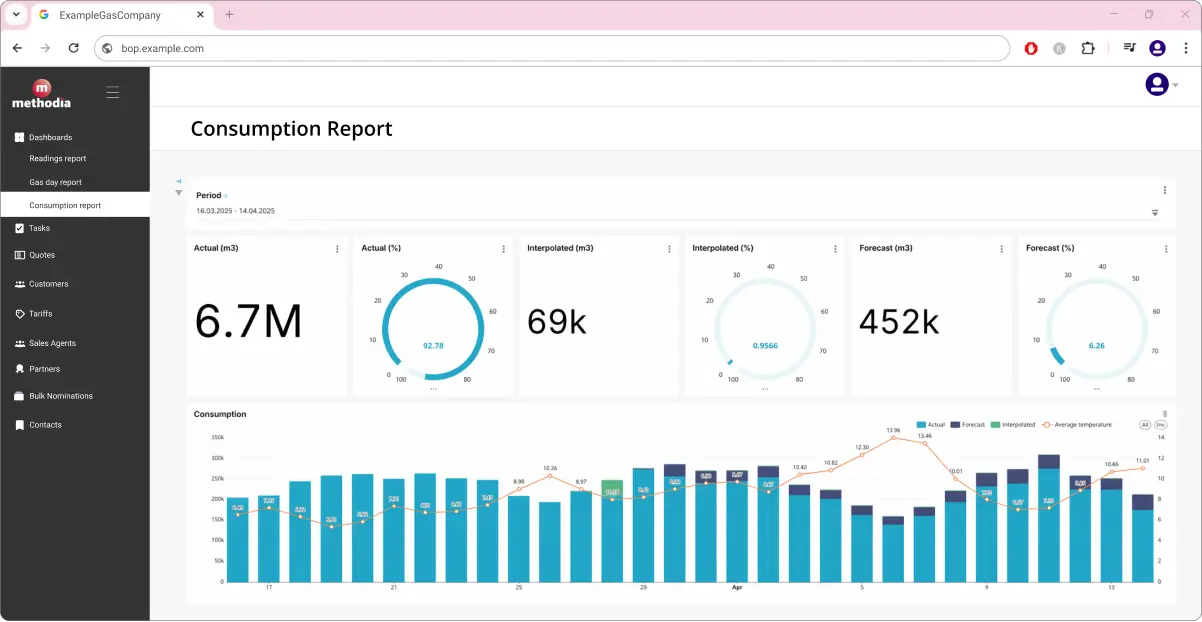
The team had to solve a challenge that sounds technical on the surface but has a very real business impact. The expected data volume for just one client was around 1 billion records per year.
When you manage gas consumption, readings, forecasts, corrections, and missing data over time, every record belongs to a specific moment.
That is what makes gas balancing hard. A forecast made yesterday, an actual read received today and a correction sent next week can all describe the same hour of the same gas day. The platform has to keep each of them in its time context, so the business can see what it knew and when, settle imbalances correctly and explain every figure to the network operator or regulator.
Final Thoughts
Choosing gas utility software starts with knowing your role in the market and which part of the stack you’re replacing. A network operator needs strong GIS, asset and field tools. A supplier needs billing that handles calorific values, switching and balancing without workarounds.
Whichever you are, test vendors on real gas scenarios, not generic demos. The right platform should handle your tariffs, your data volumes and your market processes from day one.