
The truth is that utilities do not struggle with customer communication because they lack channels, but because those channels often behave like separate systems rather than parts of one connected experience.
Here is an example of a customer journey: a customer receives a bill by email, checks account details in a portal, calls support about a payment issue, then has to repeat the same context all over again.
That is where the real problem starts.
It is not about adding more ways to contact customers. It is about making every interaction feel connected, consistent, and intelligent from start to finish.
That shift matters more than many utilities still admit. Ofgem’s latest consumer research shows that overall supplier satisfaction improved to 82% in July-August 2025, and customer service satisfaction reached 76%, the highest level since the survey began in 2018.
The message here is clear: the sector is evolving quickly, and that changes the standard. Utilities that do not connect their channels, data, and service journeys now will find it harder to keep up with both customer expectations and operational demands.
What Is Omnichannel Communication for Utilities?
Omnichannel communication for utilities means customers can move between channels such as phone, email, SMS, web chat, self-service portals, mobile apps, and agent support without losing context. In other words, the conversation continues instead of restarting.
That sounds simple, but many utility providers still operate in a multichannel model rather than an omnichannel one.
Multichannel means several channels exist.
Omnichannel means those channels are connected.
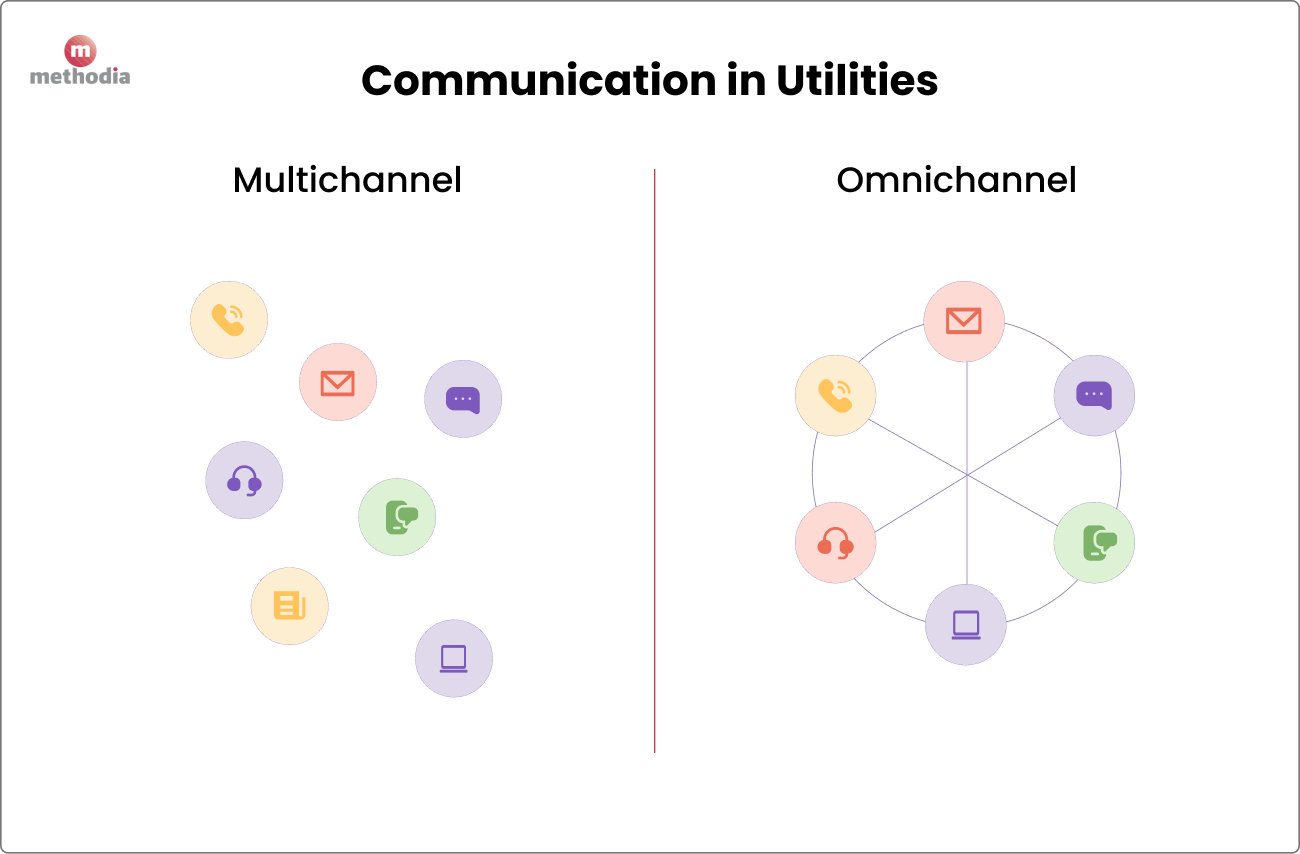
That distinction is not semantic. It is operational.
A utility may offer email support, a contact center, a billing portal, and outage notifications. But if the customer has to explain the same billing issue three times to three different teams, the experience is fragmented, no matter how many channels exist. Salesforce reports that 79% of customers expect consistent interactions across departments, yet 55% say it still feels like they are dealing with separate teams rather than one company. Another 56% say they often have to repeat or re-explain information to different representatives.
That is exactly the kind of friction utilities create when communication systems are disjoined.
Why Omnichannel Communication Matters More in Utilities
Communication is not just a customer experience layer in utilities. It sits on top of high-stakes operational moments.
A missed message can mean a failed payment journey, a complaint, or a billing dispute that drags longer than it should. Unlike many other industries, utility interactions are tied to essential services, regulated processes, and customer trust that is always under pressure.
That is why disconnected communication creates real business cost. Ofgem’s customer service data shows that across the market, suppliers recorded 1,011 complaints per 100,000 customer accounts in Q4 2025. Even with improvement, that is still a meaningful level of service friction. When utilities fail to connect communication to account history, billing context, or case status, they increase repeat contacts, extend resolution times, and push more customers into formal complaints.
In reality most communication problems in utilities are not really communication problems. They are workflow, data, and ownership problems that customers experience as communication failures.
Why Utility Communication Still Breaks Down
The first problem is channel silos.
One team owns email. Another owns the portal. Another handles inbound calls. Another may manage field-service communication or collections messages. From the inside, those teams appear organized. From the customer’s side, they often feel like different companies.
The second problem is disconnected systems.
Legacy utility CIS, billing, CRM, and service tools were rarely built to support one continuous conversation across channels. So even when a utility launches a modern self-service portal or adds live chat, the underlying experience remains fragmented because the systems behind it still do not share context well enough.
The third problem is that many utilities remain reactive.
They communicate after the problem appears instead of before it escalates. The bill has already confused the customer. The appointment has already failed. The complaint has already been lodged. The arrears process has already started. Omnichannel maturity means moving from isolated responses to orchestrated communication triggered by real operational events.
The Main Channels in an Omnichannel Utility Strategy

That is why each channel plays a different role.
According to Ofgem (the independent regulator for Great Britain’s gas and electricity markets) there are 6 main channels used to contact a supplier.
· Mobile apps/ Web portals
· Phone
· Live chat/ messaging
· Completing a web form
· Social media
· Writing a letter
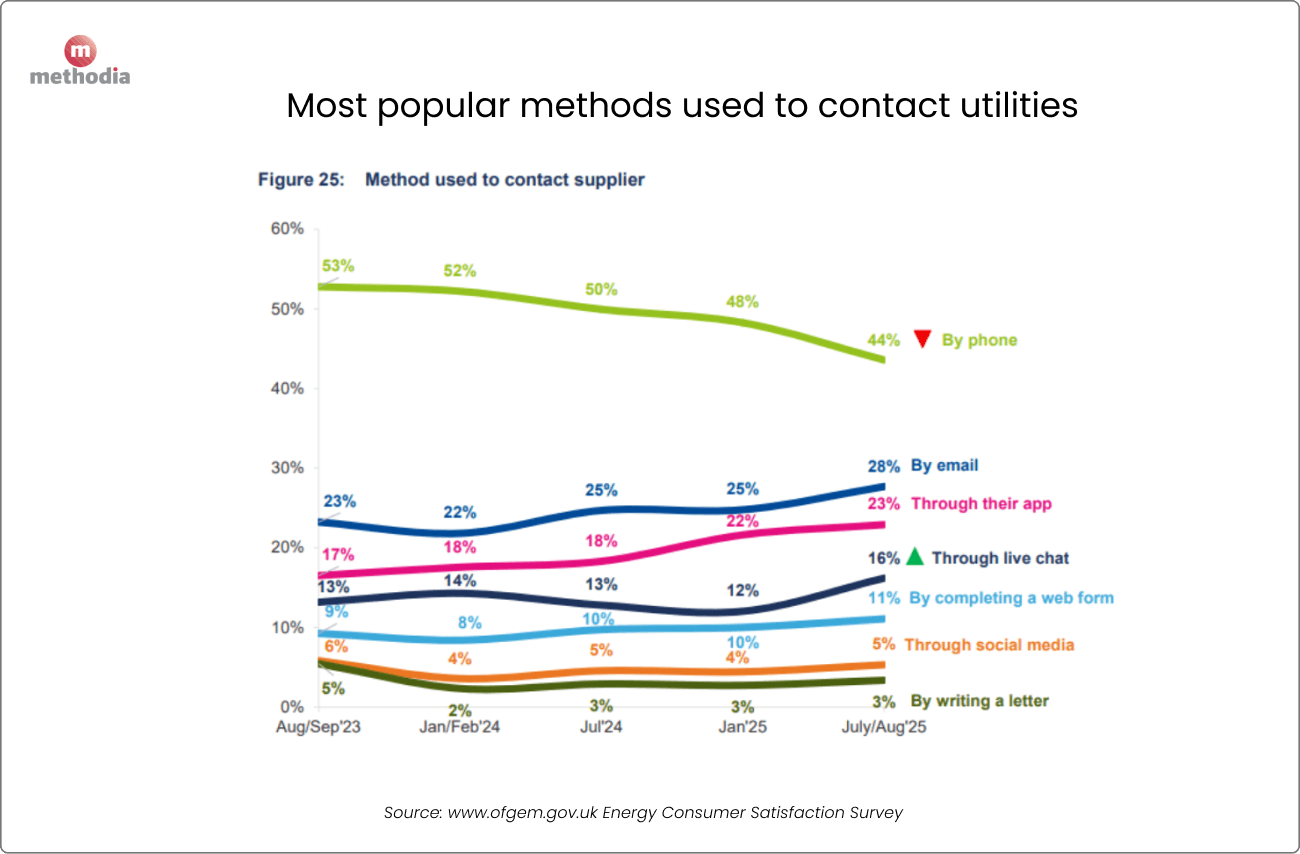
As shocking as it may sound, the most used method to contact a supplier is by phone. Yes, that is right. Second place is for email, and third for mobile app.
The lesson is not that utilities should replace phone with digital. The lesson is that customer preferences vary by context, and the real value comes from making channels work together instead of forcing one channel to do everything.
What Good Omnichannel Communication Looks Like in Practice
Omnichannel communication in utilities is the ability to manage customer interactions across all channels as one continuous, context-aware journey tied to the customer account, service status, billing history, and operational workflows.
The real shift happens when those channels are connected and the customer experience holds together from one touchpoint to the next.
In practical terms, good omnichannel communication in utilities usually has five parts.
First, the utility offers multiple channels that customers can actually use. That may include email, SMS, customer portals, mobile apps, phone support, live chat, chatbots, etc. But the presence of those channels is only the starting point. On its own, channel availability says very little about the quality of the experience.
Second, the channels are connected. This is where the model either works or falls apart. If a customer gets a bill reminder by email, clicks into the portal to review the invoice, opens a chat to ask about the amount, and then calls support, the interaction should not reset every time the channel changes. The agent should already be able to see the bill in question, recent communications, whether payment is overdue, whether a case has already been opened, and whether a payment plan or complaint is in progress. The customer should not have to reconstruct the story from the beginning. That is not a small convenience feature. It is the core of omnichannel communication.
Third, communication is tied to real utility events. This is one of the biggest differences between utilities and generic customer service environments. Utility communication should be triggered by what is actually happening in the account and operation: a bill is issued, a payment fails, a move-in request is submitted, an outage is detected, a meter appointment is booked, etc. In other words, omnichannel communication is not just about sending messages through different channels. It is about connecting those messages to real service, billing, and operational moments.
Fourth, the message has to fit the channel and the situation. Not every message belongs everywhere. SMS makes sense for appointment reminders and urgent outage alerts. Email works better for bills, confirmations, and formal notices. Portals are the right place for account history, documents, and self-service actions. Phone support is often the better route for disputes, debt conversations, complaints, and vulnerable customer cases. Chat works well for quick clarifications and simpler support needs.
Good omnichannel communication means choosing the right channel for the right purpose while keeping the journey connected behind the scenes.
Fifth, the experience feels continuous from the customer’s side. That is the real test. The utility should feel like one company, not five disconnected teams using different tools and telling different versions of the same story. When omnichannel communication works, customers do not think about channels at all. They just feel that the provider understands what is happening and helps them move forward without unnecessary friction.
A useful way to think about omnichannel communication in utilities is through five connected layers.
First is the channel layer, where communication happens. For example, through the portal, app, email, SMS, phone, chat, or letter.
Second is the context layer, which includes the account details, billing status, payment history, complaint status, service requests, usage data, vulnerability flags, and communication preferences that need to follow the customer across channels. T
Third is the journey layer, meaning the customer processes the communication belongs to, such as onboarding, first bill, payment reminder, collections, outage, complaint, moving home, meter exchange, or renewal.
Fourth is the workflow layer, which covers the internal mechanics behind the interaction, such as case creation, routing, escalation, payment arrangements, field-service scheduling, market message handling, or billing correction.
Fifth is the outcome layer, which is what the utility is actually trying to achieve: faster resolution, fewer repeat contacts, stronger self-service, fewer preventable complaints, lower cost to serve, and better customer trust.
Why Omnichannel Communication Matters in Real Utility Scenarios
That previous section may sound a bit more structural, but it becomes very practical when applied to real situations.
Take a billing question. A customer receives a bill by email and thinks the amount is too high. In a fragmented setup, they open the portal, fail to find a clear explanation, call support, repeat their account details, and reach an agent who cannot see the original message or the digital steps already taken. The issue drags on and may even become a complaint. In a good omnichannel model, the email links directly to the bill detail in the portal, the portal shows the charges and next steps clearly, the customer can open chat from that page, and the agent can immediately see the invoice, payment status, and recent communications. If the issue needs escalation, the case moves forward without losing context.
The same principle applies to missed payments. In a disconnected model, the customer may receive a reminder that feels generic and unhelpful, and that brings confusion. In an omnichannel setup, the response is connected. An SMS flags the failed payment quickly. An email follows with details and available actions. The portal shows the failed transaction and repayment options. If the customer calls, the agent already sees the failed payment and the previous communication. The point is not the volume of messages. The point is the coordinated response.
Outage communication is another clear example. In a weak setup, customers receive generic notices, the portal shows incomplete information, and the contact center has limited visibility. In a stronger omnichannel setup, affected customers receive an SMS or push notification, the portal or outage map reflects the same status, contact center agents can see the incident tied to the account, and updates continue automatically as restoration progresses. One event, multiple channels, one shared truth.
Even routine journeys like move-in and move-out become much smoother when handled this way. A customer submits a request online, receives confirmation by email, is asked for missing information through the preferred channel, gets an appointment reminder by SMS, checks status in the portal, and if they call, the agent can immediately see the whole process. That is far more useful than treating each step as a separate conversation.
But let’s also be clear about what omnichannel communication is not. It is not simply having many channels. It is not sending automated notifications and calling that strategy. It is not adding chat to the website, plugging in a CRM, or giving the portal a more modern interface. None of that, by itself, solves the real problem. You only have omnichannel communication when the channels, customer context, data, and workflows are connected well enough to support one continuous journey.
That matters more in utilities because communication is tied to money, essential services, compliance, complaints, and operational events. A poor retail communication experience may be annoying. A poor utility communication experience can mean billing confusion, delayed payment resolution, complaint escalation, missed appointments, poor outage support, higher contact volumes, and lower trust.
That is why omnichannel communication in utilities is not just a customer service tactic or a digital feature. It is an operating model choice.
The Future of Omnichannel Communication for Utilities
The future of omnichannel communication for utilities will not be defined by one channel replacing another. It will be defined by how well utilities connect the channels customers already use.
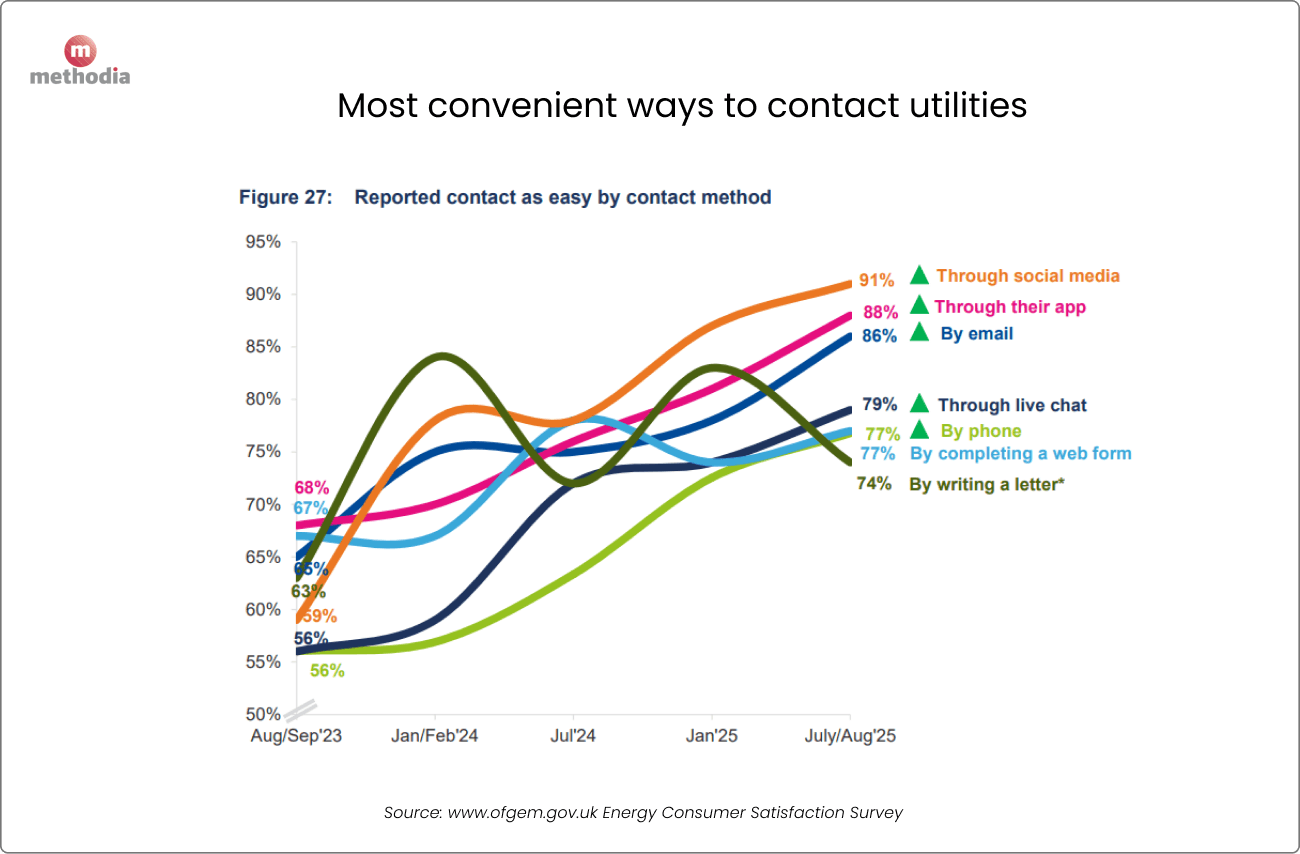
The direction is clear. Easier digital channels are gaining ground. In the chart above, social media reaches 91% for ease of contact by July/August 2025, app-based contact reaches 88%, and email reaches 86%. Live chat also performs strongly at 79%. More traditional channels still matter, but they are not setting the pace. Phone reaches 77%, web forms 77%, and letters fall behind at 74%.
At the same time, actual usage still tells a more mixed story. Phone remains the most used contact method at 44%, even after a steady decline, while email rises to 28%, app contact to 23%, and live chat to 16%.
That is the reality utilities need to design for. Customers are gradually moving toward faster, easier, lower-effort digital channels, but they have not abandoned traditional ones. Phone still matters, especially when the issue is urgent, sensitive, or difficult to resolve. So the goal is not to push everyone into digital at all costs. The goal is to make digital channels stronger for the moments they handle best, while making sure customers can move into assisted support without losing context.

💡 Is your utility company prepared for the future? Now is the time to modernize and optimize for long-term success. Methodia is here to help.


