
Most articles about the Market-Wide Half-Hourly Settlement (MHHS) Programme explain the policy. They tell you what the reform is called, why flexibility matters, and maybe throw in a timeline.
Usually that is not enough.
If you are a supplier, partner, or service provider in the UK electricity market, the real question is not “What does MHHS stand for?”
The real question is: what changes operationally, and can your systems handle it without creating new billing, data, and process headaches?
That is where MHHS gets interesting.
Ofgem approved the move to MHHS in April 2021, and its full business case estimated net consumer benefits in the range of roughly £1.6 billion to £4.5 billion through 2045, depending on the scenario. This is also no longer some distant market concept. Elexon says the programme’s 2026/27 priorities include large-scale migration, operational stability, and preparation for full cutover, with Milestone 14 on 28 October 2026 as a major checkpoint.
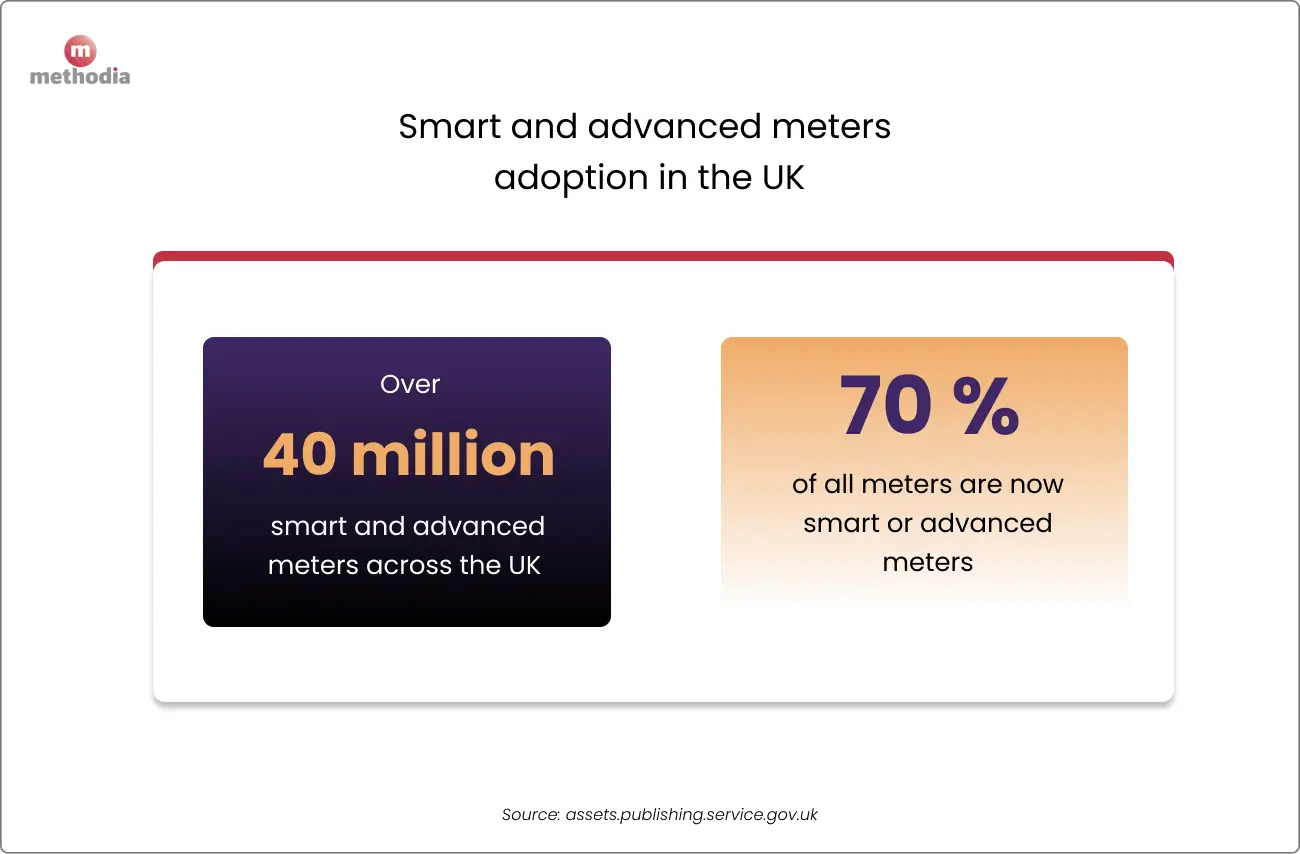
The market conditions behind MHHS are already here. By the end of September 2025, Great Britain had over 40 million smart and advanced meters in homes and small businesses, and 70% of all domestic meters were smart meters.
But no, the MHHS is not just a settlement reform. That description is too narrow. In practice, MHHS is also:
• a market communication reform,
• a data flow reform,
• and an operating model reform.
What Is Market-Wide Half-Hourly Settlement?
At a simple level, market-wide half-hourly settlement is a UK electricity market reform designed to use actual half-hourly consumption data in settlement, rather than relying heavily on estimates and profiling. The goal is to support a more efficient electricity market, better forecasting, more accurate settlement, and a stronger foundation for flexible tariffs.
That is the official version.
The MHHS Programme objective is to maximise the opportunities provided by smart metering by developing and implementing an enduring process for MHHS, that delivers benefits for consumers and enables a smart, flexible energy system.
It also helps to separate three phrases that often get blurred together:
– half-hourly settlement is the underlying settlement approach
– market-wide half-hourly settlement is the wider market reform
– MHHS programme is the implementation effort that makes the reform real through systems, rules, migration, and governance
That distinction matters because many businesses still talk about MHHS as if it were a single technical change. It is not. It is a coordinated market-wide shift.
Why Does the MHHS Programme Matters Now?
There are two lazy ways to talk about MHHS.
1. The first one is to treat it like a compliance project.
2. The second one is to treat it like a smart meter story.
Both miss the point.
MHHS matters now because the UK electricity market is trying to run on more timely, more granular, and more consistent data across a large and highly distributed set of participants. It looks like the architecture behind the programme is built for a distributed market of suppliers, registration services, data services, metering services, and network participants that need to exchange a very high volume of data and events.
That is not a small operational tweak. That is a serious industrial-scale communication problem.
And that is where standard MHHS explainers fall short. They explain the destination. They do not explain the machinery.
MHHS Is Not Just about Settlement. It Is Also about Market Communication.
Historically, a lot of industry communication happened through structured file exchanges. Files had known formats, known names, and known meanings. That worked, but it was more batch-oriented and less responsive. Information moved, but not always in the most timely or consistent way.
The MHHS Target Operating Model takes a different approach. The market is moving toward an event-driven architecture, where specific events trigger structured messages, and those messages need to be validated, routed, and consumed in the right place at the right time.
That is not just a technical architecture choice. It affects how suppliers operate.
What Is the DIP in the MHHS Programme?
The Data Integration Platform (DIP) is one of the most important concepts in MHHS, and it deserves more than a passing mention.
In the MHHS architecture, the DIP is the message-oriented, event-driven middleware layer that supports the flow of messages and events between market participants.
The important part here is that there are no direct point-to-point interfaces between participants for the relevant new message flows. Instead, messages are brokered through the DIP.
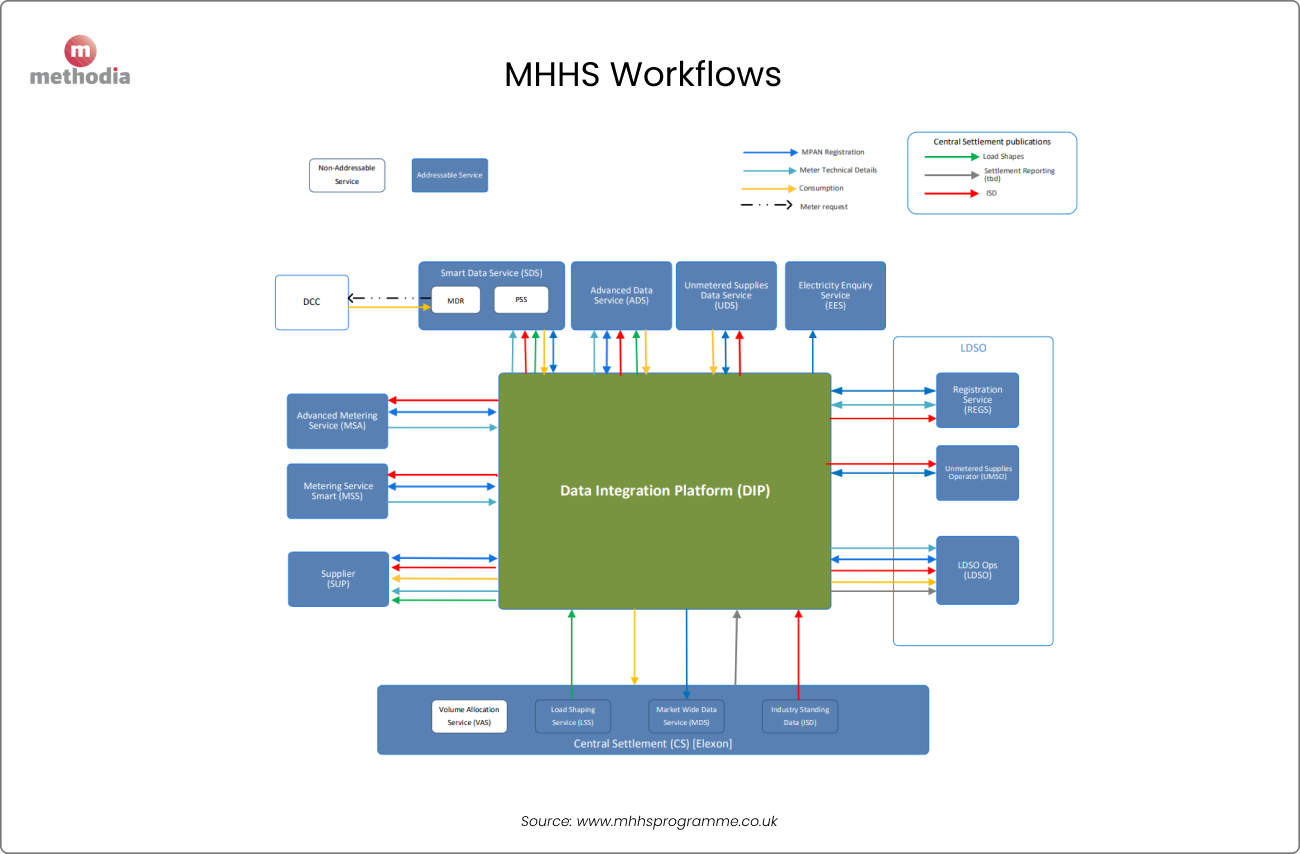
That is a much cleaner way to understand the architecture.
Rather than every participant building and maintaining endless direct integrations with every other participant, the market uses a central message-brokering layer to handle the exchange. The DIP is responsible for brokering, addressing, and routing messages between MHHS actors and services.
In practical terms, the DIP helps do things like:

- – receive messages from authorised senders
- – validate the message structure and basic security requirements
- – generate transaction references
- – archive the message
- – determine the right routing logic
- – send the message onward to the correct recipients
This matters because the DIP is not just a pipe. It is a governed market communication layer.
What the DIP Does and What It Does Not Do
The DIP does a lot of heavy lifting around message exchange. But it is not responsible for orchestrating business process itself, such as ensuring that every correlated message exchange happens in sequence.
That distinction matters.
If the DIP is the industry’s event-driven messaging backbone, suppliers still need a system layer that can turn those market messages into operational action. They need software that can recognise what an incoming event actually means, map it to the right business process, preserve the original message for traceability, transform the data for downstream systems, trigger the right internal actions, and support billing, customer, and operational workflows around the event.
This is where reliable platforms such as Methodia fit into the picture.
Methodia helps suppliers operationalise those messages inside their own environment. In practice, that means taking an incoming MHHS-related event, identifying the process behind it, retaining the original message for auditability, adapting it for the systems that need to consume it, and ensuring the right billing, customer, or market workflow follows.
So, the clean way to explain it is this: the DIP moves and governs market messages, while Methodia helps suppliers turn those messages into controlled, traceable business processes.
Why DIP Matters Commercially, Not Just Technically
DIP matters because better market communication is not just an IT improvement. It has commercial consequences.
When information is delayed, inconsistent, badly transformed, or poorly routed, the damage does not stay inside integration diagrams. It shows up in the real world as:
• billing issues
• process delays
• poor customer communication
• operational rework
• disputes between participants
• weak auditability
That is why the event-driven model matters. The architecture is trying to reduce friction across a high-volume, multi-party market.
What MHHS Changes for Suppliers in Practice
For suppliers, MHHS is not just a background settlement reform. It changes how quickly the market moves, how data is exchanged, and what supplier systems need to support day to day.
One of the clearest changes is the settlement timetable. Under the legacy model, settlement could take up to 14 months. Under MHHS, that reduces to 4 months, with the first financial settlement run also moving earlier. That means suppliers have less time to identify issues, correct bad data, resolve exceptions, and get inputs right before settlement closes.
At the same time, suppliers move into a more event-driven market model.
That affects not just settlement teams, but the wider supplier operating model too.
In practical terms, MHHS changes several things for suppliers:
Settlement happens faster. The window for reconciliation shrinks, so errors and exceptions need to be identified and resolved earlier.
Data handling becomes more demanding. Suppliers need systems that can ingest, validate, and use more granular consumption-related data.
Market communication becomes more time-sensitive. Incoming events need to be recognised, routed, and linked to the right internal processes quickly enough to avoid delays or breakdowns.
Billing and tariff operations get harder. More granular settlement and usage inputs raise the bar for rating, billing readiness, and exception handling. This is an inference from the faster settlement model and broader half-hourly usage inputs.
Financial risk shifts earlier. Because settlement completes faster, suppliers have less room to carry unresolved issues deep into the process.
That is the point many MHHS summaries miss. The programme does not just give suppliers better data. It forces them to operate on tighter timelines, with more granular inputs, in a faster market communication model.
If supplier systems cannot ingest, interpret, route, and act on that information properly, then MHHS does not create operational improvement. It just exposes where the operating model is still too slow, too manual, or too fragmented.
Where Methodia Fits into the MHHS Picture
MHHS is not just a market reform. For suppliers, it is an operational challenge.
As settlement speeds up and market processes become more connected, suppliers need systems that help them stay accurate, responsive, and in control. That is where Methodia adds value.
Methodia already works with UK energy clients, so this is not a theoretical topic for us. We understand that MHHS affects more than settlement alone. It has implications for billing, customer operations, market processes, and traceability across systems.
Methodia already helps suppliers manage that operational reality. Instead of leaving teams to stitch everything together manually, it helps create stronger control across workflows, visibility, and downstream processes.
We have also partnered with EPTECH to support UK electricity providers in the MHHS transition, combining Methodia’s operational platform with specialist UK market and regulatory expertise.
MHHS Timeline: Why This Is No Longer Theoretical
This is not early-stage thought leadership anymore.
Ofgem’s decision to proceed with MHHS was published in April 2021. Since then, the programme has moved through implementation phases and industry milestones. Suppliers began moving meters to half-hourly settlement in October 2025 and the market is targeting around 80% of meters accepted into the new arrangements by October 2026.
The implementation is expected to complete in May 2027.
That changes the tone the market needs. The useful MHHS content now is not generic awareness content. It is content that helps buyers understand what changes, where the risk sits, and what capabilities they need in place.
💡 Is your utility company prepared for the future? Now is the time to modernize and optimize for long-term success. Methodia is here to help.


